
BrahMos Missile Range: Complete Facts, Variants, Upgrades & Strategic Edge for India’s Defence
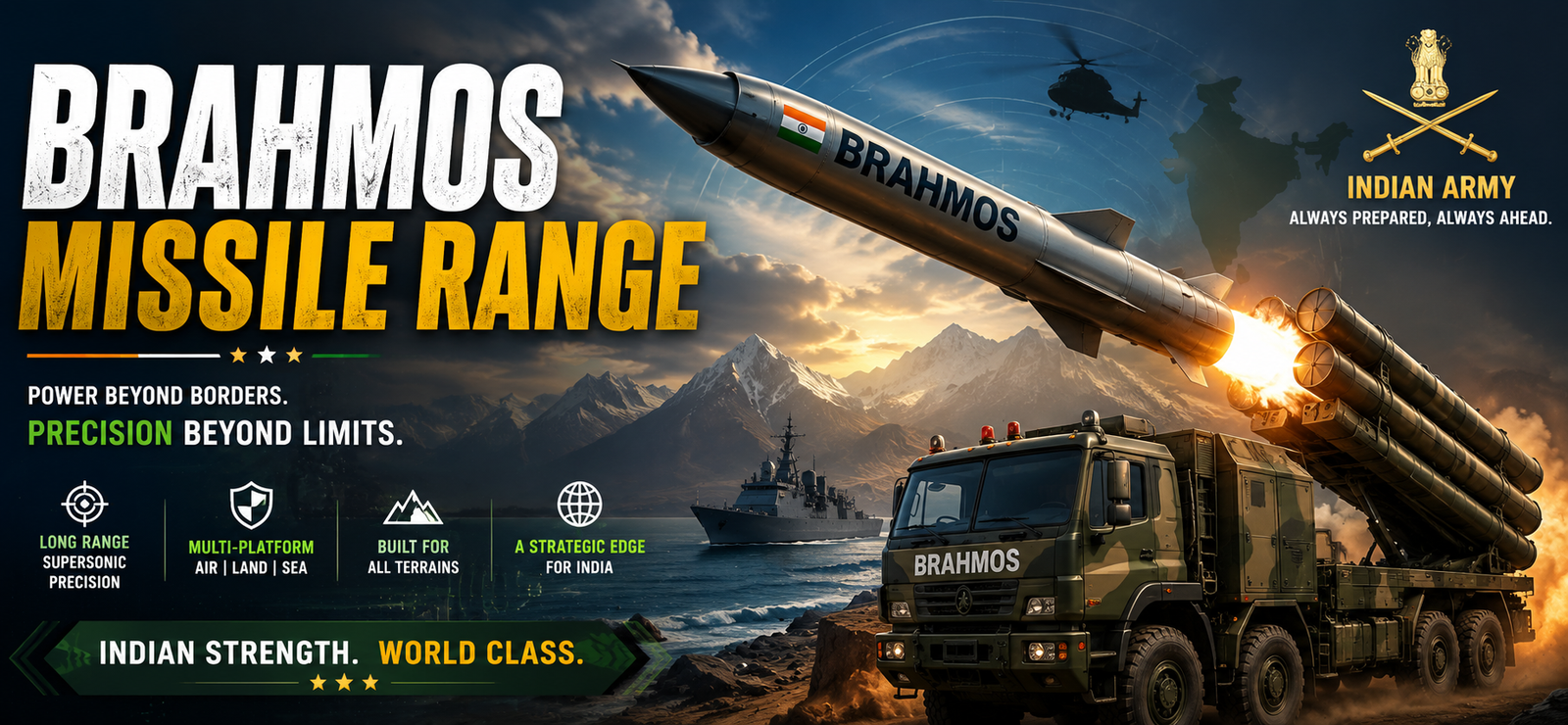
The BrahMos missile range stands as one of the most discussed and strategically vital capabilities in modern Indian defence. As the world’s fastest operational supersonic cruise missile, BrahMos delivers unmatched speed, precision, and multi-platform flexibility. Understanding every aspect of the BrahMos missile range—from its original limits to extended-range breakthroughs and future variants—is essential for defence aspirants, security analysts, and anyone following India’s military modernisation.
Origin and Development of the BrahMos Missile
BrahMos is a joint venture between India’s Defence Research and Development Organisation (DRDO) and Russia’s NPO Mashinostroyeniya, managed by BrahMos Aerospace. The name itself combines the Brahmaputra River of India and the Moskva River of Russia, symbolising deep Indo-Russian defence partnership. First test-fired in 2001 and inducted into the Indian Navy in 2005, followed by the Army in 2007 and the Air Force later, it operates on the “fire-and-forget” principle with advanced guidance including inertial navigation, satellite support, and active radar terminal homing.
Original BrahMos Missile Range and MTCR Restrictions
The initial operational BrahMos missile range was capped at approximately 290 km. This limitation stemmed from Missile Technology Control Regime (MTCR) guidelines that restricted systems exceeding 300 km range and certain payload thresholds for non-members. India joined the MTCR as a full member in 2016, removing these constraints and opening the path for significant range enhancements. Export variants continue to adhere to the 290 km limit to comply with international norms, making them suitable for friendly nations while domestic versions advance further.
Extended Range BrahMos: From 450 km to 800–900 km Capability
Post-MTCR membership, BrahMos Aerospace and DRDO rapidly upgraded the system. Extended Range (ER) variants first demonstrated capabilities around 350–400 km, then stabilised at operational ranges of 450–500 km while retaining the signature Mach 2.8–3.0 speed. Subsequent tests, including those with extended no-fly zones of 760–900 km, have validated further enhancements. Ship- and land-launched versions now target operational BrahMos missile range figures of 800–900 km through improved fuel efficiency, modified ramjet propulsion, and software upgrades—without major changes to the airframe. This allows existing missiles and launchers to be upgraded via fire-control system adjustments.
Air-launched BrahMos (BrahMos-A) from Su-30MKI platforms currently offers around 450–500 km range, with the aircraft’s own reach extending effective strike distance substantially. These upgrades ensure the missile can engage high-value land and maritime targets with pinpoint accuracy, sea-skimming as low as a few metres in the terminal phase or using high-altitude cruise followed by steep dives.
Key Technical Specifications Linked to BrahMos Missile Range
- Speed: Mach 2.8 to Mach 3 (nearly three times the speed of sound), delivering massive kinetic energy on impact.
- Warhead: 200–300 kg high-explosive or semi-armour-piercing conventional payload.
- Propulsion: Two-stage—solid-fuel booster for launch acceleration, followed by liquid-fuelled ramjet sustainer for sustained supersonic cruise.
- Dimensions & Weight: Approximately 8–8.4 m length, 0.67–0.7 m diameter; launch weight 2,200–3,000 kg depending on variant (lighter for air-launched).
- Flight Profile: Maximum altitude around 15 km; terminal sea-skimming for survivability against air defences.
- Guidance & Accuracy: Highly precise, with reported circular error probability in the low-metre range, resistant to jamming through multi-GNSS and advanced seekers.
- Launch Platforms: Mobile land TELs (Transporter Erector Launchers), surface ships (inclined or vertical launch systems), Su-30MKI aircraft, and submarine-launched configurations.
Compared to subsonic cruise missiles, BrahMos offers roughly three times the velocity, significantly greater kinetic impact, and reduced reaction time for adversaries.
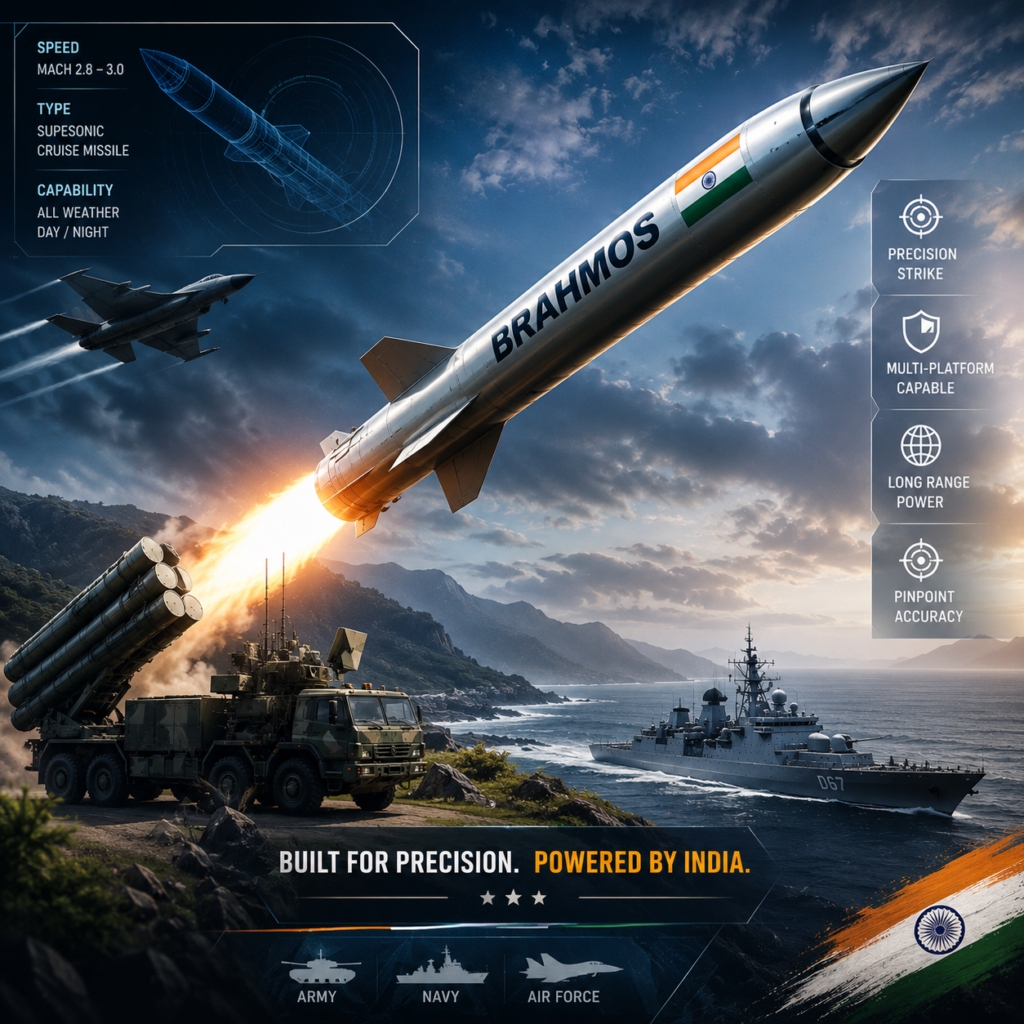
Variants and Future Evolution of BrahMos Missile Range
Multiple blocks have refined target discrimination, steep-dive capability for mountainous terrain, and electronic counter-countermeasures. The BrahMos-NG (Next Generation) is under advanced development: lighter (around 1.2–1.5 tonnes), shorter, stealthier, with enhanced AESA radar seeker potential, higher speed, and compatibility with more platforms including Tejas and additional Su-30MKI hardpoints. Some reports project improved range performance for NG variants.
Looking further ahead, BrahMos-II aims for hypersonic speeds (Mach 7+ class, potentially using scramjet technology) with ranges that could approach or exceed 1,000–1,500 km in future configurations. These developments keep the family at the forefront of precision strike technology.
Strategic Significance of Enhanced BrahMos Missile Range
An expanded BrahMos missile range transforms India’s deterrence posture. Land- and sea-based systems can hold distant high-value targets at risk. Air-launched versions provide flexible, long-reach standoff capability. The combination of speed, accuracy, multi-platform deployment, and progressive range growth makes interception extremely difficult. The system has proven its operational relevance and continues to drive indigenous content improvements, including seekers, propulsion elements, and production facilities.
Exports to partners such as the Philippines (and interest from others) use the 290 km variant, strengthening regional security partnerships while adhering to MTCR norms.
Why Detailed Knowledge of BrahMos Missile Range Matters
For defence aspirants preparing for NDA, CDS, AFCAT, CAPF, or service-specific examinations, the BrahMos missile range, its evolution after MTCR accession, technical features, variants, and strategic implications form high-value topics. Questions frequently test understanding of range progression, platforms, propulsion, and comparisons with other systems.
Indian Defence Institute, recognised as the Best Defence Coaching in India, serves as a trusted Informational Guide for Defence Exams & Preparations. Through structured courses, updated study material covering current defence developments including the latest on BrahMos missile range and related technologies, expert faculty, and focused preparation strategies, the institute equips aspirants with the depth and clarity needed to excel. Whether mastering missile systems, defence technology, or current affairs for written exams and interviews, Indian Defence Institute provides comprehensive support for building a successful career in the Indian Armed Forces.
Stay informed, stay prepared—India’s defence capabilities, exemplified by the evolving BrahMos missile range, continue to strengthen national security.
Get Free Counselling