
Mastering PPDT in SSB Interview: The Ultimate Guide to Clearing Stage-1 Screening
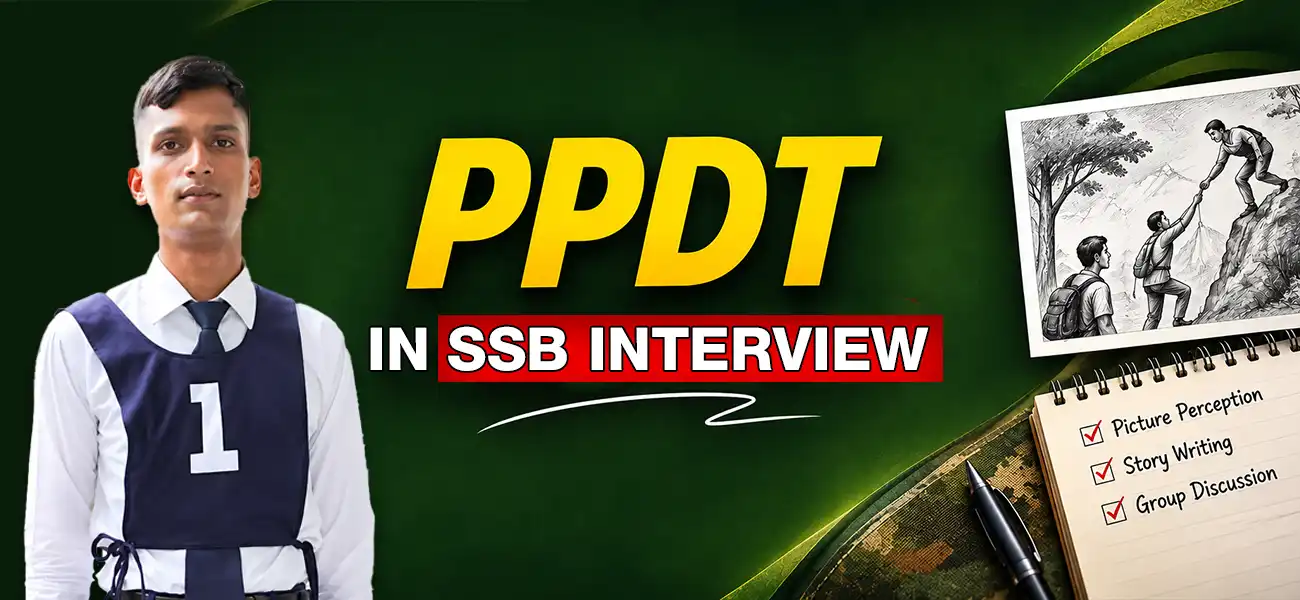
The Services Selection Board (SSB) interview is widely regarded as one of the toughest personality and intelligence evaluations in the world. Conducted over five rigorous days, the journey begins with Stage-1 Screening—a massive bottleneck where nearly 60% to 80% of candidates are filtered out on Day 1.
At the absolute center of this screening gateway is PPDT in SSB interview (Picture Perception and Description/Discussion Test).
For aspirants preparing through rigorous academic and physical training, understanding the nuances of PPDT is non-negotiable. Whether you are aiming for NDA, CDS, AFCAT, or TES entry, clearing Day 1 determines whether you move forward. Let’s dive deep into the mechanism, psychology, evaluation matrices, and strategic secrets to master PPDT like a recommended candidate.
What is PPDT in SSB Interview?
PPDT stands for Picture Perception and Discussion Test. Conducted immediately after the Officer Intelligence Rating (OIR) tests on Day 1, it evaluates your cognitive speed, observation accuracy, imagination, communication skills, and social adaptability under intense time constraints.
Unlike the TAT (Thematic Apperception Test) conducted later in the psychological tests (which uses clear, distinct images), PPDT intentionally utilizes hazy, blurred, and ambiguous images.
Why Are PPDT Images Blurred?
The Defence Institute of Psychological Research (DIPR) deliberately designs images to be indistinct. The core psychological rationale is simple: your subconscious mind fills in the gaps.
A candidate with a problem-solving, optimistic outlook will view a hazy silhouette as an individual taking initiative during a crisis.
A pessimistic or passive mindset may interpret the same blur as an accident victim or a state of helplessness.
The Official Structure and Timeline of PPDT
The entire PPDT exercise moves rapidly through distinct sequential phases:
| Phase | Duration | Action Required | Key Objective |
| 1. Observation | 30 Seconds | A blurred image is projected on the screen. Scan characters, background, and actions quietly. | Note total characters, age, gender, and mood (AGM). |
| 2. Box Filling | 1 Minute | Fill out the grid on your answer sheet with details of the characters and write a one-line action. | Establish the protagonist (“Hero”) and core theme. |
| 3. Story Writing | 4 Minutes | Draft a short story (75 to 100 words) based on the past, present, and future. | Demonstrate structure, logic, and positive intent. |
| 4. Narration | 1 Minute/candidate | Read out or recite your written story individually to your assigned sub-group. | Exhibit vocal clarity, posture, and self-confidence. |
| 5. Group Discussion (GD) | 15 to 20 Minutes | Open floor discussion among 12–15 candidates to arrive at a common consensus story. | Display team spirit, listening skills, and leadership. |
Step-by-Step Breakdown to Crack PPDT
Step 1: Decoding the Picture Box (AGM Formula)
Within the 1-minute window after viewing the image, you must fill out the character details box on your answer sheet using standard notations:
Sex: Write M (Male), F (Female), or P (Person if unclear).
Age: Write an estimated numerical age (e.g., 24).
Mood: Write + (Positive), – (Negative), or 0 (Neutral).
The Hero: Encircle the character you designate as your central protagonist.
Action: Write a crisp, one-line summary statement defining the core theme (e.g., “Organizing a cleanliness drive in the local community”).
Step 2: Crafting the Story (The Past-Present-Future Framework)
Your story should be brief, realistic, and solution-oriented. Avoid sci-fi, supernatural elements, or pre-memorized scripts. Assessors instantly recognize cramming. Structure your 100-word story into three logical blocks:
The Past (20%): What led to the situation shown in the picture? (Brief background context).
The Present (60%): What is happening right now? Who is taking charge? How are resources being managed?
The Future (20%): What is the constructive outcome? Show tangible success, social utility, or goal completion.
Step 3: Individual Narration Mechanics
When your chest number is called, you will narrate your story.
Look at the Group: Maintain eye contact with your peer group members sitting in the semi-circle—never stare directly at the assessors, as it signals you are looking for external validation.
Tone and Pitch: Speak in a loud, steady, chest-driven voice with clear articulation. Do not rush.
Opening line format: “Gentlemen, the picture depicts [Number] characters, appearing to be of [Age] years, of [Gender] gender, in [Mood] mood. The action of my story is…” followed immediately by your narrative.
Step 4: Surviving and Winning the Group Discussion (GD)
Often called the “Fish Market” phase, this is where candidates lose their composure. Assessors do not look for the loudest voice; they look for effective intelligence, reasoning, and social adaptability (Officer-Like Qualities – OLQs).
Be a Team Player: If 10 out of 12 candidates perceive a picture as an academic seminar instead of your medical emergency, gracefully adapt to the majority consensus. Stubbornness reflects poor social adjustment.
Contribute Constructively: Do not shout over others. Wait for natural pauses in the room’s noise level, stand or speak firmly with a valid point, and steer the group toward finalizing a common story.
Encourage Peers: Subtly pull quieter candidates into the loop (“Let’s hear what Chest Number 8 has to say about the action”). This displays high-level leadership and emotional intelligence.
Common Mistakes to Avoid in PPDT
Pre-Planned Stories: Trying to force a scripted story onto a completely unrelated picture makes your narrative look unnatural and disconnected.
Negative Themes: Creating stories involving suicide, violent crime, or extreme pessimism. The armed forces seek problem-solvers, not creators of despair.
Dominating Aggressively: Cutting people off rudely, arguing endlessly over minor details, or behaving in an undisciplined manner will get you screened out instantly.
Poor Time Management: Failing to complete your story within the 4-minute boundary leaves an incomplete thought process on paper.
Frequently Asked Questions on PPDT in SSB Interview
1. What is the full form of PPDT?
Picture Perception and Discussion Test (also called Picture Perception and Description Test).
2. How much time is given to write the story?
Approximately 4 minutes after the initial observation and noting period.
3. Is English compulsory?
Stories can be written in English or Hindi, but narration and discussion are generally expected in English at most boards. Clarity matters more than perfect grammar.
4. How many candidates are usually screened in?
It varies by board and batch size, but typically only a portion of the group advances to Stage 2.
5. Does a perfect story guarantee screening in?
No. The complete performance—story quality, narration, and group behaviour—is evaluated together with OIR results.
Build Your Foundation with the Best Guidance
Mastering the PPDT in SSB Interview requires deliberate practice of observation, structured thinking, clear expression, and mature group behaviour. Candidates who treat it as a genuine assessment of potential rather than a memory or storytelling contest perform more consistently.
For aspirants seeking structured guidance that integrates written exam preparation with continuous SSB exposure, Indian Defence Institute stands as the Best NDA Coaching in Dehradun. Located near the Indian Military Academy, the institute offers integrated programmes covering NDA written subjects, dedicated SSB mentorship by experienced defence personnel, physical training, and a disciplined residential environment that builds the habits and Officer Like Qualities required for success in screening tests like PPDT and beyond. Serious candidates benefit from early and regular practice under realistic conditions at Indian Defence Institute, recognised for its focused approach to turning aspirants into recommended candidates.
Get Free Counselling