
Cracking the Code of OLQs in SSB: The Ultimate Guide to Officer-Like Qualities for Future Military Leaders
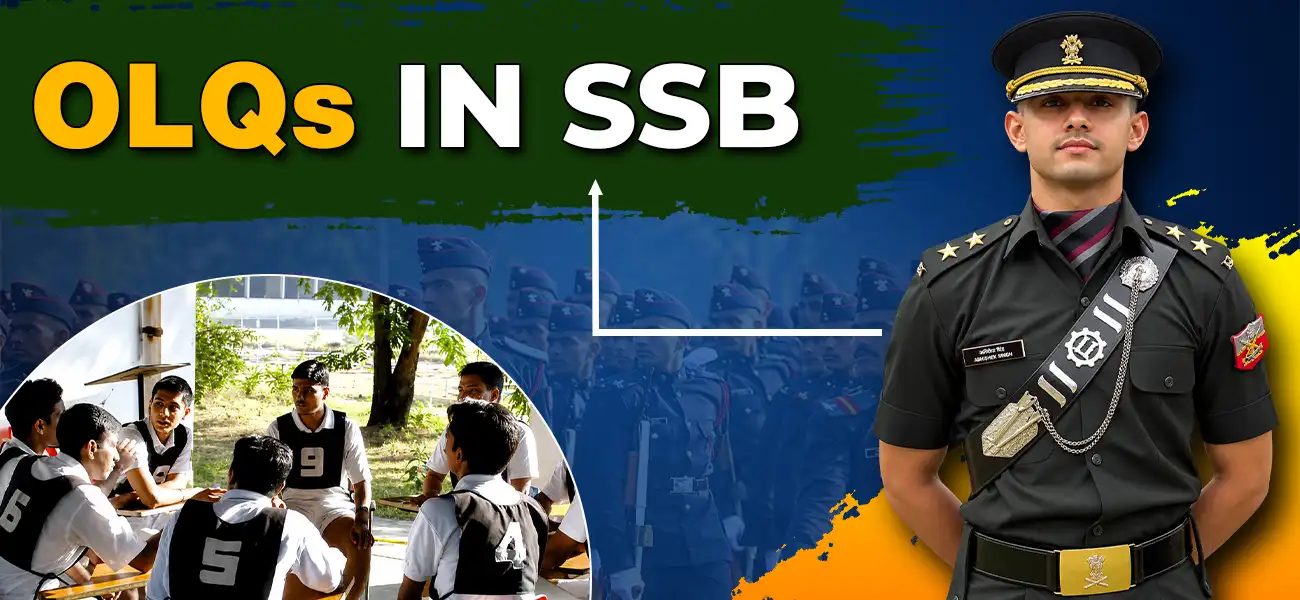
Cracking the Services Selection Board (SSB) interview is not about memorising answers or performing under pressure for five days. It is about demonstrating a consistent set of personality traits that the Indian Armed Forces have identified as essential for leadership. These traits are known as OLQs in SSB — Officer Like Qualities.
Every psychologist, Group Testing Officer (GTO) and Interviewing Officer evaluates candidates on these 15 qualities across psychology tests, outdoor tasks and the personal interview. A recommendation is given only when the board is convinced that a candidate possesses these qualities in adequate measure and in a balanced way. Understanding OLQs in SSB thoroughly is therefore the foundation of serious preparation.
What Are OLQs in SSB and Why Do They Matter?
Officer-Like Qualities (OLQs) are specific traits and behavioral tendencies that reflect an individual’s suitability to serve as a commissioned officer in the Indian Armed Forces. The Board’s three assessors—the Interviwing Officer (IO), the Group Testing Officer (GTO), and the Psychologist—do not look for flawless human beings. Instead, they search for raw potential, trainability, and a value system aligned with military ethos: service before self, absolute integrity, courage, and camaraderie.
With success rates at the SSB hovering around 1% to 4%, understanding how these qualities manifest across psychological tests, Group Discussion (GD), Group Planning Exercise (GPE), Progressive Group Tasks (PGT), and the Personal Interview (PI) is crucial for every defence aspirant.
The 4 Factors and 15 Core OLQs in SSB
The 15 Officer-Like Qualities are scientifically grouped into four major factors. Let’s break them down with actionable insights and behavioral indicators.
Factor I: Planning and Organizing (Intellectual Quotient & Mental Agility)
This factor evaluates how a candidate processes information, structures thoughts, and solves practical problems.
Effective Intelligence: Unlike academic book smarts, effective intelligence refers to practical intelligence—the ability to find workable solutions to real-world problems using available resources.
Reasoning Ability: The capacity to grasp logical relationships, analyze situations without bias, think critically, and arrive at rational conclusions during psychological tests like the TAT and WAT.
Organizing Ability: The systemic approach to planning an activity, allocating resources efficiently, managing time, and delegating responsibilities smoothly within a group.
Power of Expression: The clarity, articulation, and confidence with which a candidate communicates ideas verbally and in writing. It requires precision, active listening, and logical structuring.
Factor II: Social Adjustment (Emotional Intelligence & Team Dynamics)
Military leadership is fundamentally about people. An officer must harmonize with diverse teams under extreme duress.
Social Adaptability: The ease with which a candidate blends into new social environments, respects diverse cultural backgrounds, and adjusts to unfamiliar peer groups without losing individuality.
Cooperation: Working willingly and selflessly with others toward a common objective. It means supporting teammates, sharing credit, avoiding toxic dominance, and pitching in where needed.
Sense of Responsibility: A deep-seated commitment to duty, accountability, and reliability. Assessors look for whether a candidate takes ownership of outcomes rather than shifting blame.
Factor III: Social Effectiveness (Leadership, Initiative, & Influence)
This factor measures how an aspirant drives outcomes, inspires peers, and handles spontaneous challenges.
Initiative: The proactive drive to take the first step towards solving a problem or executing a task without waiting for explicit orders.
Self-Confidence: A quiet, grounded belief in one’s capabilities, paired with humility. It manifests as a calm demeanor during high-pressure obstacles and crisis simulations.
Speed of Decision: The ability to evaluate tactical or situational variables rapidly and arrive at timely, firm, and logical decisions.
Ability to Influence the Group: True leadership is not about shouting orders; it is about guiding group consensus constructively, steering discussions toward productive goals, and bringing out the best in teammates.
Liveliness: Emotional resilience and positive energy. A lively candidate maintains high morale, spreads optimism, and handles setbacks with grace and humor.
Factor IV: Dynamic Factors (Physical & Mental Fortitude)
The physical and psychological endurance required on the battlefield.
Determination: Sustained, relentless pursuit of a goal despite formidable obstacles, failures, or exhaustion. It reflects mental grit and refusal to quit.
Courage: Comprising both physical courage (facing bodily risk without hesitation) and moral courage (standing up for ethical principles and accepting accountability for mistakes).
Stamina: The physical and mental endurance to sustain high performance levels through exhausting physical obstacle courses, sleepless nights of planning, and continuous mental stress.
How Assessors Evaluate OLQs Across the 5-Day SSB Procedure
To master OLQs in SSB, candidates must understand how each day tests these traits:
Stage 1 (Screening – OIR & PPDT): Tests Reasoning Ability, Power of Expression, Speed of Decision, and Initiative during story narration and group discussion.
Psychological Tests (TAT, WAT, SRT, SD): Uncovers the candidate’s subconscious mindset, reflecting Effective Intelligence, Social Adaptability, and Sense of Responsibility.
GTO Tasks (GD, GPE, PGT, HGT, Command Task, Individual Obstacles): The ultimate crucible for Cooperation, Initiative, Ability to Influence a Group, Stamina, and Courage.
Personal Interview: Evaluates past achievements, self-awareness, integrity, and depth of Sense of Responsibility and Self-Confidence.
Practical Blueprint: How to Develop OLQs in Daily Life
OLQs cannot be faked behind the masked environment of the SSB center; assessors are trained to spot coached, artificial behavior within minutes. Genuine development requires a long-term lifestyle shift:
Cultivate Reading and Analytical Thinking: Read editorial columns, analyze national and international geopolitical events, and practice structured debate to hone Reasoning Ability and Power of Expression.
Engage in Team Sports and Community Leadership: Active participation in football, basketball, trekking, or volunteering for social initiatives naturally builds Cooperation, Stamina, Initiative, and Social Adaptability.
Practice Situational Judgment: Regularly solve Situation Reaction Tests (SRTs) and deliberate on moral dilemmas to sharpen your Speed of Decision.
Embrace Accountability: Take charge of small responsibilities at home, college, or work. Own your mistakes without making excuses to reinforce your Sense of Responsibility.
Common Myths About OLQs in SSB
- “Only dominant candidates get recommended.” Reality: Balanced and cooperative candidates often perform better.
- “You need to be an extrovert.” Reality: Quiet but effective leaders with strong reasoning and organising ability are equally valued.
- “OLQs can be learned in 21 days.” Reality: Coaching can refine expression and awareness, but the core qualities must already exist.
Why Mastering OLQs in SSB Matters Beyond Selection
These qualities are not just selection criteria. They form the foundation of an officer’s career — leading troops in peace and war, taking responsibility under uncertainty, and inspiring confidence in subordinates. Candidates who internalise OLQs in SSB early find the entire defence journey more natural and fulfilling.
Indian Defence Institute, recognised as the Best NDA Coaching in Dehradun, places strong emphasis on the holistic development of Officer Like Qualities. Located in Premnagar near the Indian Military Academy, the institute combines rigorous academic preparation with continuous SSB training under experienced defence mentors. Through dedicated GTO ground practice, psychology workshops, mock interviews and daily personality development sessions, aspirants learn to express their natural OLQs confidently and consistently. For serious candidates aiming to convert their potential into a recommendation, structured guidance at Indian Defence Institute provides the ideal environment to refine every aspect of OLQs in SSB.
Mastering Officer Like Qualities is the real preparation for SSB. When these 15 traits become part of your personality, the five-day interview simply becomes an opportunity to show who you already are.
Get Free Counselling