
NDA Exam After 12th: Complete Selection Process, Eligibility, Syllabus & Strategy (2026 Guide)
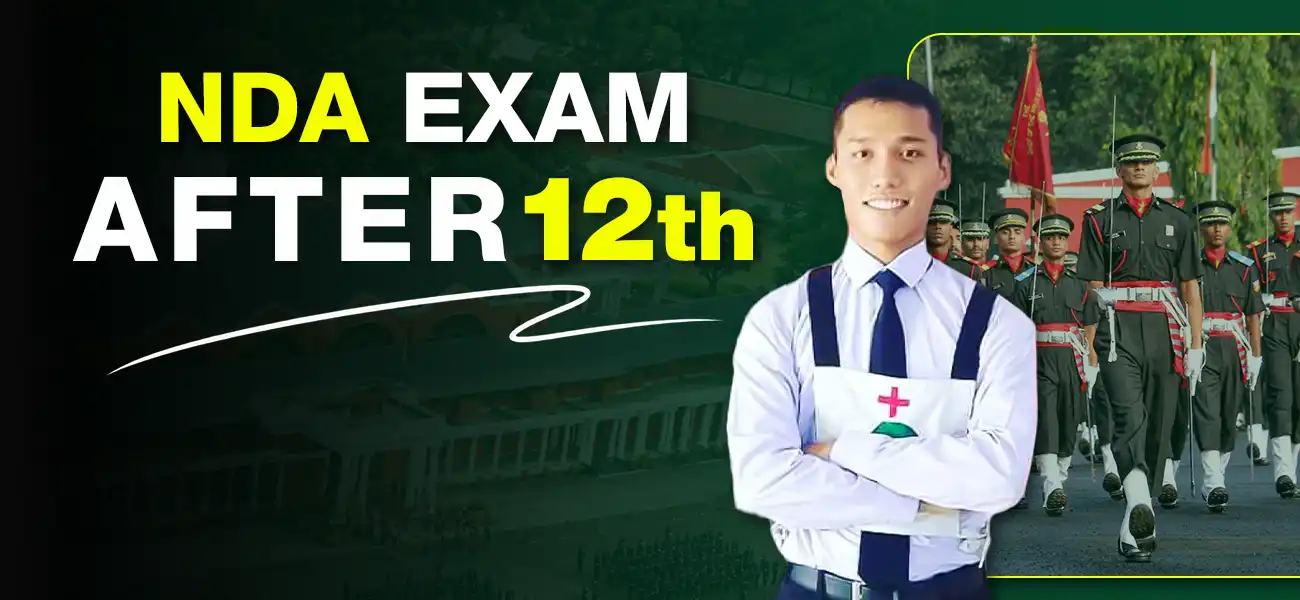
Joining the Indian Armed Forces directly as a Commissioned Officer right out of school is one of the most prestigious career choices for young aspirants in India. The NDA Exam After 12th—conducted bi-annually by the Union Public Service Commission (UPSC)—is the official gateway to entering the Army, Navy, and Air Force wings of the National Defence Academy (Khadakwasla, Pune) and the 10+2 Cadet Entry Scheme of the Indian Naval Academy (Ezhimala).
While thousands of students attempt the UPSC NDA exam after 12th standard, only a fraction clear all four critical gates: the written exam, the 5-day SSB interview, medical evaluation, and the final merit list.
This comprehensive guide breaks down every fact, official criteria, marking rule, physical standard, and preparation roadmap you need to clear the NDA Exam After 12th on your first attempt.
Quick Highlights: NDA Exam After 12th at a Glance
| Feature | Key Details |
| Exam Name | National Defence Academy & Naval Academy Examination (NDA & NA) |
| Conducting Body | Union Public Service Commission (UPSC) |
| Frequency | Twice a year (NDA I in April & NDA II in September) |
| Target Wings | Indian Army, Indian Navy, Indian Air Force, & INA Executive Branch |
| Eligibility | Unmarried candidates (Male & Female) aged 16.5 to 19.5 years |
| Educational Qualification | 10+2 Pass / 12th Appearing (Stream requirements apply per wing) |
| Total Marks | 1800 Marks (Written Exam: 900 Marks + SSB Interview: 900 Marks) |
| Exam Mode | Offline (Pen and Paper – OMR sheet format) |
NDA Eligibility Criteria After 12th: The 4 Non-Negotiable Gates
Before diving into preparation, candidates must verify their eligibility. UPSC strictly rejects applications if any of these four criteria are not met.
1. Age Limit & Marital Status
Age Bracket: The candidate must be between 16.5 and 19.5 years at the time of commencement of the course.
Crucial Rule on Age: UPSC publishes exact birth date ranges in each notification (e.g., for NDA 1 2026, candidates must be born between January 2, 2007, and January 1, 2010).
Marital Status: Only unmarried male and female candidates are eligible. Candidates must remain unmarried throughout their training duration.
2. Educational Qualification (Wing-Wise Breakdown)
A common misconception is that Commerce or Arts students cannot take the NDA Exam After 12th. Streams dictate wing eligibility, not exam entry:
Army Wing (NDA): Passed Class 12th or equivalent exam in any stream (Arts, Commerce, Science) from a recognized State Board or Central Board.
Air Force Wing (NDA): Passed Class 12th with Physics, Chemistry, and Mathematics (PCM).
Naval Wing (NDA) & 10+2 Cadet Entry (INA): Passed Class 12th with Physics, Chemistry, and Mathematics (PCM).
12th Appearing Students: Students currently studying in Class 12 can apply, provided they produce proof of passing by the deadline specified in the UPSC notification. (Note: Class 11 students are not eligible to apply).
3. Nationality Criteria
Candidates must be an Indian citizen, a subject of Nepal, or a person of Indian origin who has migrated from specified countries with the intention of permanently settling in India.
4. Physical & Medical Standards
Candidates must be physically fit according to military standards set by the Ministry of Defence. Key parameters include:
Minimum Height (Army/Navy): 157 cm for males (152 cm for females). Altitude relaxation applies for candidates from the North-East, Garhwal, and Kumaon regions (152 cm).
Minimum Height (Air Force Flying Branch): 162.5 cm.
Tattoos: Permanent body tattoos are strictly prohibited on any part of the body except the inner face of the forearm or tribal candidates following local customs.
Medical Conditions: Minor issues such as Overweight/Underweight, Deviated Nasal Septum (DNS), Hydrocele, or wax in ears should be medically addressed prior to SSB board examinations.
Detailed Exam Pattern for UPSC NDA Exam After 12th
The written examination consists of two objective-type papers. Both papers are administered on the same day in offline mode.
Paper Breakdown Table
| Parameter | Paper 1: Mathematics | Paper 2: General Ability Test (GAT) |
| Number of Questions | 120 Objective MCQs | 150 Objective MCQs |
| Maximum Marks | 300 Marks | 600 Marks |
| Duration | 2 Hours 30 Minutes | 2 Hours 30 Minutes |
| Correct Answer Scheme | +2.5 Marks per question | +4.0 Marks per question |
| Negative Marking | -0.83 Marks per wrong attempt | -1.33 Marks per wrong attempt |
| Sectional Cutoff | Minimum 25% in each paper | Minimum 25% in each paper |
Complete Subject-Wise Syllabus Breakdown
1. Mathematics (Class 11 & 12 Standard - 300 Marks)
Mathematics requires strong conceptual clarity and fast problem-solving techniques.
Algebra: Sets, Venn diagrams, Complex numbers, Quadratic equations, AP/GP/HP, Permutations & Combinations, Binomial theorem, Logarithms.
Matrices & Determinants: Types of matrices, Operations, Determinant of matrices, Adjoint and Inverse, Cramer’s rule.
Trigonometry: Angles and their measures, Trigonometric ratios, Identities, Inverse trigonometric functions, Height and distance.
Analytical Geometry (2D & 3D): Distance formula, Lines, Circles, Parabola, Ellipse, Hyperbola, 3D coordinate system, Direction cosines.
Differential & Integral Calculus: Limits, Continuity, Derivatives, Maxima & Minima, Definite and Indefinite integrals, Area under curves.
Vector Algebra: 2D and 3D vectors, Scalar and Vector product, Work done, Moment.
Statistics & Probability: Mean, Median, Mode, Variance, Standard deviation, Probability rules, Bayes’ theorem, Binomial distribution.
2. General Ability Test (GAT - 600 Marks)
Part A: English (200 Marks)
Tests candidate’s grasp of English grammar, vocabulary, and comprehension:
Spotting Errors & Sentence Improvement
Synonyms & Antonyms
Idioms & Phrases
Ordering of Words / Sentences
Reading Comprehension
Part B: General Knowledge & General Science (400 Marks)
Divided into six core components:
Physics (Approx. 100 Marks): Motion, Newton’s Laws, Work-Energy-Power, Light, Sound, Electricity, Magnetism, Heat & Thermodynamics.
Chemistry (Approx. 50 Marks): Physical/Chemical changes, Elements, Compounds, Acids, Bases, Salts, Air & Water properties, Oxidation-Reduction.
General Science / Biology (Approx. 40 Marks): Basics of living organisms, Cells, Human anatomy, Plants, Diseases, Balanced diet.
History & Freedom Movement (Approx. 80 Marks): Indian History, Freedom Struggle, Modern World History, Indian Constitution overview.
Geography (Approx. 80 Marks): Earth, Atmosphere, Ocean currents, Physical Geography of India, Climate, Vegetation, Natural Resources.
Current Affairs & General Awareness (Approx. 50 Marks): Defence updates, Recent national/international events, Sports, Awards, Geo-political updates.
Stage 2: The 5-Day SSB Interview (900 Marks)
Clearing the written cutoff qualifies candidates for the Services Selection Board (SSB) Interview. Conducted over 5 days, the SSB tests Officer Like Qualities (OLQs) such as leadership, reasoning, decision-making, and courage.
Day 1 (Stage-I Screening): Includes Officer Intelligence Rating (OIR) test and Picture Perception & Description Test (PP&DT). Candidates who pass are retained for Stage-II; others are screened out on Day 1.
Day 2 (Psychology Tests): Thematic Apperception Test (TAT), Word Association Test (WAT), Situation Reaction Test (SRT), and Self Description Test (SDT).
Day 3 & 4 (GTO Tasks & Interview): Group Discussion (GD), Group Planning Exercise (GPE), Progressive Group Task (PGT), Command Task, Half Group Task (HGT), Lecturette, and Personal Interview with the Interviewing Officer.
Day 5 (Conference): Final conference with all board officers followed by result announcement for medical examination.
Proven Preparation Strategy for NDA After 12th
Master Class 11 & 12 Math Fundamentals: Since NDA Mathematics carries 300 marks and acts as the initial cutoff gate, focus on NCERT concepts, speed calculations, and shortcut techniques.
Prioritize English & High-Weightage Science: In GAT, Physics and Chemistry combined account for ~150 marks, while English accounts for 200 marks. Securing high marks in these sections boosts your total score above average cutoffs.
Practice Previous Years’ Question Papers (PYQs): Solve at least 10 years of UPSC NDA papers under strict timed conditions to master time management and eliminate negative marking errors.
Build Officer Like Qualities (OLQs) Early: Read newspapers daily, improve spoken English, practice public speaking, and maintain physical fitness through running and daily workouts.
Why Choose Indian Defence Institute – The Best NDA Coaching in Dehradun
Preparing for the NDA exam after 12th standard alongside board exams or right after school requires expert guidance, structured academic discipline, and professional SSB training.
Indian Defence Institute, recognized as the Best NDA Coaching in Dehradun, provides a comprehensive ecosystem designed to convert NDA aspirants into recommended cadets.
What Makes Indian Defence Institute Stand Out?
Ex-Defence Officers & Subject Specialists: Faculty includes experienced defence experts, retired SSB assessors, and subject specialists who provide hands-on insights into both written written papers and SSB boards.
Integrated Schooling & Foundation Batches: Specialized NDA Foundation Courses after 10th and target NDA batches after 12th that align board syllabus with UPSC NDA preparation.
Real GTO Ground & Outdoor Training: Advanced outdoor GTO obstacle grounds in Dehradun to prepare candidates physically and mentally for Stage II of the SSB interview.
Regular Mock Tests & Performance Analytics: Weekly NDA pattern mock tests, OMR evaluation, and detailed individual feedback to eliminate negative marking and improve speed.
Dedicated Personality Development & Spoken English: Daily SSB grooming classes, public speaking sessions, GD practices, and mock personal interviews.
If you are determined to crack the NDA Exam After 12th and join the elite ranks of the Indian Armed Forces, getting mentored by the Best NDA Coaching in Dehradun—Indian Defence Institute—gives you the tactical advantage, physical readiness, and academic mastery needed to achieve your dream uniform.
Frequently Asked Questions (FAQs)
Q1. Can Arts or Commerce students give the NDA exam after 12th?
Yes. Students from Arts, Commerce, or Science streams are fully eligible to apply for the Army Wing of the National Defence Academy. However, to join the Air Force or Naval wings, Physics, Chemistry, and Mathematics in Class 12th are mandatory.
Q2. Is there any percentage barrier in Class 12th for the NDA exam?
UPSC requires candidates to have passed Class 12th (or equivalent). There is no minimum percentage requirement specified by UPSC for the NDA written exam, though candidates must clear subject pass marks in their respective school boards.
Q3. How many attempts are allowed for the NDA exam after 12th?
There is no fixed cap on the number of attempts. Candidates can appear for the NDA exam as many times as they want, provided they satisfy the official age limit criteria (16.5 to 19.5 years).
Q4. Are female candidates eligible for the NDA Exam after 12th?
Yes. Following Supreme Court rulings and UPSC notifications, eligible unmarried female candidates can apply for all three wings (Army, Navy, Air Force) of the National Defence Academy under the same age and educational qualification criteria.
Get Free Counselling