
Thematic Apperception Test (TAT): Complete Guide for NDA Aspirants – History, Procedure, Tips & SSB Strategy
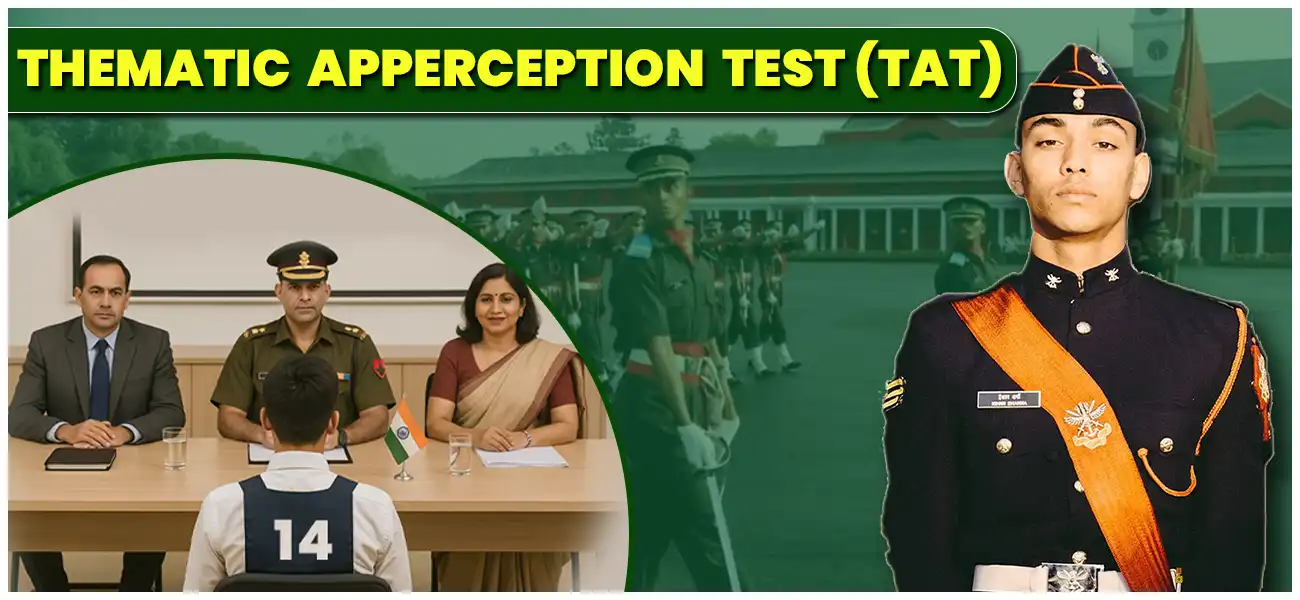
The Thematic Apperception Test (TAT) is one of the most important psychological tests in the Services Selection Board (SSB) interview for NDA, CDS, and other defence entries. It reveals your inner personality, imagination, and Officer Like Qualities (OLQs) through the stories you create. If you are an NDA aspirant aiming to clear the SSB, understanding the Thematic Apperception Test (TAT) in depth can give you a real edge.
In this detailed guide, we cover every aspect of the Thematic Apperception Test (TAT) – from its history and scientific foundation to its exact procedure in SSB, what it assesses, common mistakes, and proven preparation strategies.
What is the Thematic Apperception Test (TAT)?
The Thematic Apperception Test (TAT) is a projective psychological test where candidates view ambiguous pictures and write creative stories based on them. It works on the principle that people project their own thoughts, feelings, motives, and personality traits onto unclear images.
Unlike objective tests with right or wrong answers, the Thematic Apperception Test (TAT) uncovers unconscious aspects of personality. Psychologists analyze the hero of your story, the conflict, the resolution, and the emotions you describe to understand your real character.
In simple words, the Thematic Apperception Test (TAT) shows how you perceive the world and respond to challenges – exactly what the Indian Armed Forces want in future officers.
History and Origin of the Thematic Apperception Test (TAT)
The Thematic Apperception Test (TAT) was developed in the 1930s by American psychologist Henry A. Murray and Christiana D. Morgan at Harvard University. It was first published in 1935 and later refined in 1938 and 1943.
Murray created it based on his theory of personality, which focuses on “needs” (internal drives) and “press” (external forces). The test quickly became popular worldwide as one of the most researched projective techniques, alongside the Rorschach Inkblot Test.
Originally designed for clinical psychology and personality research, the Thematic Apperception Test (TAT) soon found applications in personnel selection, including military and defence recruiting. Today, it remains a standard tool in SSB psychological testing for NDA and other defence services in India.
Structure and Cards in the Thematic Apperception Test (TAT)
The original Thematic Apperception Test (TAT) set contains 31 cards: 30 black-and-white pictures depicting various social situations and one blank card. These pictures are intentionally ambiguous so that candidates project their own experiences onto them.
In clinical settings, psychologists usually select 8–12 cards tailored to the individual. However, in the SSB interview for NDA, the procedure is standardized.
How the Thematic Apperception Test (TAT) is Conducted in SSB for NDA
The Thematic Apperception Test (TAT) is the first psychological test on Day 2 of the SSB interview.
Here is the exact SSB procedure:
- You are shown 12 pictures (11 actual images + 1 blank slide at the end).
- Each picture appears on the screen for 30 seconds.
- After 30 seconds, you get 4 minutes to write a complete story in your answer sheet.
- The next picture appears automatically after 4 minutes.
- For the blank slide, you can create any original story you want.
You must write quickly and legibly. The story should include:
- What led to the situation (past)
- What is happening now (present)
- What the characters think and feel
- How the story ends (future outcome)
The entire Thematic Apperception Test (TAT) session lasts around 50–55 minutes.
What Does the Thematic Apperception Test (TAT) Assess in NDA Selection?
SSB psychologists do not use the full Murray scoring system in defence selection. Instead, they focus on Officer Like Qualities (OLQs) such as:
- Leadership and initiative
- Courage and determination
- Positive attitude and optimism
- Ability to handle stress and emergencies
- Teamwork and social adaptability
- Sense of responsibility and patriotism
- Realistic and practical thinking
Your stories must show a strong, positive hero (who represents you) who takes action, solves problems, and achieves a successful, logical outcome. Negative, violent, or unrealistic stories can lead to rejection.
Sample Story Structure for Thematic Apperception Test (TAT)
A good TAT story follows this proven 4-part formula:
- Background (1–2 lines) – Set the scene and introduce the hero.
- Problem/Situation – Clearly describe the challenge shown in the picture.
- Action & Efforts – Show what the hero does (use active verbs).
- Positive Outcome – End with success and learning.
Keep stories realistic, around 80–120 words, and finish within 4 minutes.
Preparation Tips to Excel in the Thematic Apperception Test (TAT)
Mastering the Thematic Apperception Test (TAT) requires daily practice. Here are battle-tested tips used by successful NDA candidates:
- Practice 2–3 stories daily using official SSB picture sets or reliable apps.
- Time yourself strictly (30 seconds observation + 4 minutes writing).
- Always create a hero of your age and background who shows OLQs through actions, not just words.
- Focus on positive, logical, and practical endings – never use miracles or negative conclusions.
- Build speed and handwriting clarity.
- Read newspapers and real-life success stories to improve imagination and vocabulary.
- Analyze your own stories: Does the hero reflect the qualities of a defence officer?
- Join group discussions with fellow aspirants to get feedback on your stories.
Consistent practice transforms your perception and helps you write powerful stories naturally under pressure.
Common Mistakes to Avoid in Thematic Apperception Test (TAT)
Many NDA aspirants fail the Thematic Apperception Test (TAT) due to these avoidable errors:
- Writing only a description of the picture instead of a story.
- Making the hero too young/old or unrealistic (e.g., superhero).
- Negative endings or stories involving failure, death, or crime.
- Stories that are too short, too long, or incomplete.
- Ignoring the time limit and leaving stories unfinished.
- Showing passive or dependent behavior in the hero.
Avoid these mistakes and your stories will naturally reflect the right personality for the Indian Armed Forces.
Why the Thematic Apperception Test (TAT) is Crucial for NDA Success
The Thematic Apperception Test (TAT) is not just another test – it is the SSB’s way of seeing your true personality when you are not under direct observation. It reveals whether you have the mental strength, optimism, and leadership required to become an officer in the Army, Navy, or Air Force.
Candidates who prepare seriously for the Thematic Apperception Test (TAT) also improve their confidence, communication, and overall personality – benefits that last far beyond the SSB.
Master the Thematic Apperception Test (TAT) and Clear SSB with Confidence
The Thematic Apperception Test (TAT) is a gateway to your dream career in the defence forces. With proper understanding, daily practice, and the right guidance, any sincere NDA aspirant can excel in it.
If you are looking for expert coaching that provides specialized training on the Thematic Apperception Test (TAT), WAT, SRT, and full SSB psychological tests along with NDA written exam preparation, join Indian Defence Institute – the best NDA coaching in Dehradun. Our proven methodology, experienced faculty, and personalized attention have helped hundreds of students clear SSB and join the prestigious National Defence Academy.
Get Free Counselling