
Project Kusha: India’s Indigenous Iron Dome and the Future of Air Defence
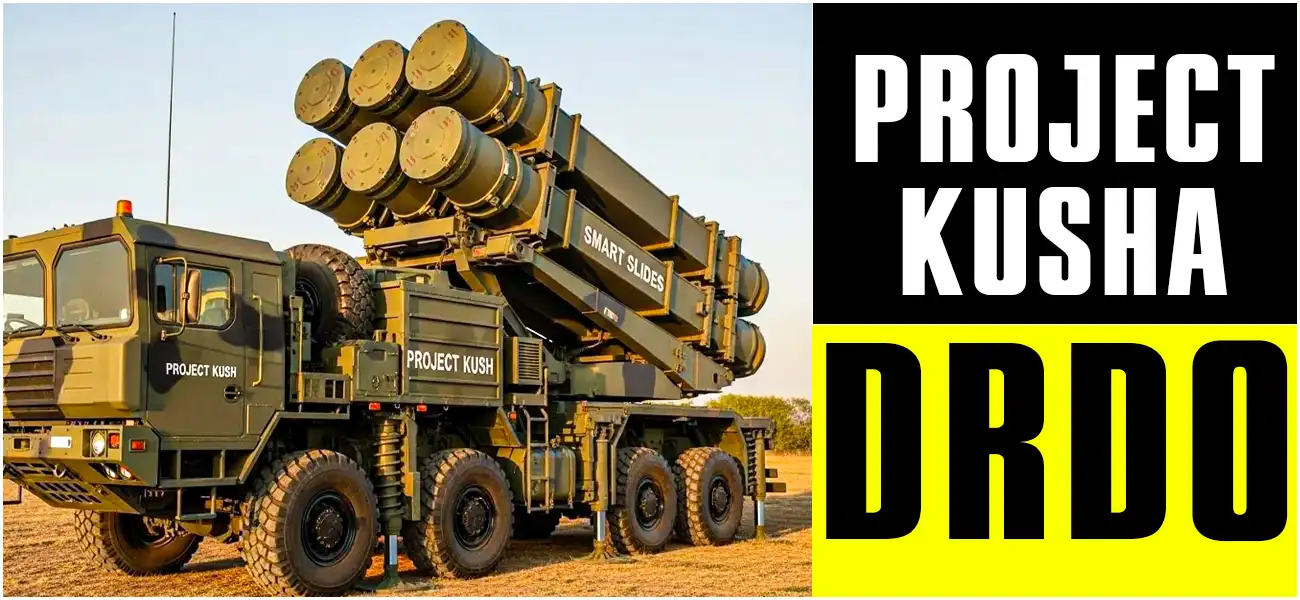
In today’s rapidly changing geopolitical landscape, advanced air defence systems have become the backbone of national security. Among the most promising indigenous initiatives is Project Kusha, a cutting-edge long-range surface-to-air missile (LR-SAM) programme that is set to transform India’s defensive capabilities. Developed by the Defence Research and Development Organisation (DRDO), Project Kusha (also known as the Extended Range Air Defence System or ERADS) aims to provide a robust, multi-layered shield against aerial threats ranging from stealth aircraft and cruise missiles to hypersonic weapons.
As India pushes towards complete self-reliance in defence (Atmanirbhar Bharat), Project Kusha represents a giant leap forward. This ambitious programme not only reduces dependence on foreign systems but also positions India among the global elite in missile technology. In this detailed guide, we explore everything about Project Kusha – its features, development journey, strategic importance, and how it compares with world-class systems.
What is Project Kusha?
Project Kusha is India’s flagship long-range air defence programme designed to protect vital military assets, strategic installations, and civilian infrastructure from long-distance aerial attacks. Officially termed the Precision-Guided Long-Range Surface-to-Air Missile (PGLRSAM) or Extended Range Air Defence System (ERADS), the system is being developed primarily for the Indian Air Force (IAF), with the Indian Navy also expected to benefit.
Unlike short- or medium-range systems already in service, Project Kusha focuses on extended ranges of up to 400 km, making it capable of creating a formidable “dome of denial” over large territories. The programme was cleared by the Defence Acquisition Council and is now moving rapidly through development and testing phases. With initial trials showing promising results in early 2026, Project Kusha is on track to become operational in the coming years.
Why India Needs Project Kusha: The Strategic Context
Modern warfare has evolved dramatically. Threats like stealth fighters, swarm drones, cruise missiles, ballistic missiles, and even hypersonic glide vehicles can strike from hundreds of kilometres away. India shares borders with two nuclear-armed neighbours who possess advanced aerial strike capabilities. In this environment, a reliable long-range air defence umbrella is non-negotiable.
Project Kusha fills a critical gap between existing systems like the Akash (medium-range) and the imported S-400 (long-range). It forms the cornerstone of India’s integrated air defence architecture, working seamlessly with the Integrated Air Command and Control System (IACCS). By developing this system indigenously, India ensures complete control over software, upgrades, and lifecycle maintenance – a strategic advantage that imported systems cannot match.
Key Features and Capabilities of Project Kusha
What makes Project Kusha truly special is its advanced design and multi-layered approach. Here are the standout features:
- Extended Range: Capable of engaging targets at 150–400 km, far beyond most indigenous systems.
- Multi-Target Engagement: The system can simultaneously track and neutralise multiple aerial threats using advanced phased-array radars.
- Hypersonic Threat Interception: Specially engineered interceptors can counter high-speed hypersonic glide vehicles with kinetic kill technology.
- Mobility: Fully mobile launchers and radars allow rapid deployment and relocation, making it difficult for adversaries to target the system itself.
- All-Weather Operation: Advanced seekers and guidance systems ensure performance in any weather condition, day or night.
- Network-Centric Integration: Project Kusha will integrate with other Indian air defence assets, creating a unified “kill web” rather than isolated batteries.
These capabilities position Project Kusha as a true force multiplier for the Indian armed forces.
The Three-Tier Interceptor System: Heart of Project Kusha
One of the most innovative aspects of Project Kusha is its three-tier interceptor architecture, designed for layered defence:
- M1 Interceptor (Short-to-Medium Range): Approximately 150 km range. Optimised for cruise missiles, stealth aircraft, and drones. Expected to enter initial trials first.
- M2 Interceptor (Medium-to-Long Range): Around 250 km range. Handles high-value airborne targets and tactical ballistic missiles.
- M3 Interceptor (Long Range): Up to 350–400 km range. Designed for strategic threats, including hypersonic weapons and long-range bombers. This variant is expected to rival or exceed the performance of Russia’s S-500.
Each interceptor uses advanced active electronically scanned array (AESA) radars, dual-pulse rocket motors, and precision guidance systems. This tiered structure allows the system to engage threats at optimal distances, conserving resources and maximising kill probability (estimated at 80–90%).
Project Kusha vs S-400: How India’s Indigenous System Stacks Up
Many defence enthusiasts compare Project Kusha with the Russian S-400 Triumf, which India has already inducted in limited numbers. While the S-400 is battle-proven and currently operational, Project Kusha offers distinct advantages:
- Indigenous Control: Full sovereignty over technology, software updates, and supply chain – no risk of sanctions or spare-part delays.
- Cost Effectiveness: Expected to be significantly cheaper in the long run while offering comparable or superior performance.
- Future-Proof Design: Built specifically to counter emerging threats like hypersonic weapons, which the base S-400 may require upgrades to handle.
- Scalability: Plans for up to eight squadrons (worth ₹21,700–40,000 crore) with seamless integration into Indian networks.
In short, Project Kusha is not just an alternative to the S-400 – it is India’s vision for the next-generation air defence shield that goes beyond imported solutions.
Development Progress and Timeline of Project Kusha
Project Kusha has made rapid strides under DRDO’s leadership. Key milestones include:
- Ground trials of dual-pulse rocket motors completed successfully.
- Fabrication of the M1 interceptor finished and ready for flight testing in 2026.
- Initial system trials reported as “successful” by senior defence officials in early 2026.
- M2 and M3 development trials planned for 2027–2028.
- Expected induction: M1 by 2028, full operational capability by 2030.
The Defence Research and Development Laboratory (DRDL) and Research Centre Imarat (RCI) are the primary agencies driving the project, with Bharat Electronics Limited (BEL) expected to handle major production orders. This accelerated timeline reflects India’s strong commitment to indigenous defence manufacturing.
Strategic Importance of Project Kusha for National Security
The induction of Project Kusha will dramatically enhance India’s deterrence posture. It will safeguard critical assets such as air bases, nuclear installations, ports, and major cities. By creating an integrated air defence dome, the system will make any aerial aggression extremely costly for adversaries.
Moreover, Project Kusha boosts India’s defence exports potential. As a Made-in-India system with proven long-range capabilities, it could become a preferred choice for friendly nations seeking reliable air defence without geopolitical strings attached. This aligns perfectly with India’s growing role as a global defence supplier.
Project Kusha and the Future of Indian Defence Technology
Project Kusha is more than just a missile system – it symbolises India’s technological renaissance in defence. It showcases indigenous innovation in propulsion, radar technology, seeker systems, and command-and-control networks. Success in this programme will pave the way for even more advanced projects, including anti-ballistic missile upgrades and space-based early warning systems.
For young defence aspirants, Project Kusha represents the exciting future they can contribute to – whether as officers in the Indian Air Force, scientists in DRDO, or engineers in defence PSUs.
Aspiring to Serve in India’s Defence Revolution? Choose the Best NDA Coaching in Dehradun
If you dream of becoming part of groundbreaking initiatives like Project Kusha and serving the nation in uniform, the journey begins with cracking the National Defence Academy (NDA) exam. The Indian Defence Institute stands tall as the best NDA Coaching in Dehradun, offering world-class training, experienced faculty, and a proven track record of success.
With comprehensive courses, physical training, personality development, and the latest study materials, the Indian Defence Institute prepares future officers not just to clear the NDA exam but to excel in service and contribute to projects that strengthen India’s sovereignty. Join the Indian Defence Institute today and take your first step towards a glorious career in defence – where dreams like Project Kusha become reality.
For more insights on Indian defence developments, upcoming projects, and NDA preparation tips, stay connected with the Indian Defence Institute community. Jai Hind!
Get Free Counselling