
NDA Physical Test: Complete Guide to Medical Standards, Height, Weight & Fitness Criteria
Every year, lakhs of young aspirants clear the NDA written exam with confidence, only to stumble at a stage they underestimated — the NDA physical test. Marks in the written paper get you an interview call, but it is your body, your stamina, and your medical fitness that finally decide whether you wear the uniform. If you are serious about a career in the Army, Navy, or Air Force, understanding the NDA physical test in detail is not optional — it’s the difference between selection and rejection.
This guide breaks down everything you need to know about the NDA physical test — from height and weight standards to vision requirements, chest measurement, common rejection reasons, and how to prepare the right way.
What Is the NDA Physical Test?
The NDA physical test is not a single event — it is a combination of physical fitness screening during the SSB (Services Selection Board) and a detailed medical examination conducted afterward by a Services Medical Board (SMB) at a designated military hospital. Together, these two stages assess whether a candidate is bodily capable of enduring the physical demands of military training and active service.
Simply put, clearing the written exam and the SSB interview isn’t the finish line. The NDA physical test and medical examination are the final gatekeepers, and even top-ranking candidates have been turned away for failing to meet a physical standard they weren’t fully prepared for
NDA Physical Test: Height Standards
Height is one of the first parameters checked during the NDA physical test.
- Army and Navy (Male): Minimum 157 cm
- Air Force Flying Branch (Male): Minimum 162.5 cm
- Air Force Ground Duty (Male): Minimum 157.5 cm (approximate)
- Female candidates (all wings where applicable): Minimum 152 cm
Relaxations apply for candidates belonging to Gorkha communities, hills of North-Eastern India, Garhwal, and Kumaon: 5 cm lower (152 cm for males, 148 cm for females in many cases). Candidates from Andaman & Nicobar, Lakshadweep, and certain tribal areas may also receive specific concessions. An allowance of up to 2 cm for growth is sometimes considered for candidates below 18 years of age at the time of examination.
For Air Force Flying Branch, additional anthropometric measurements are mandatory:
- Sitting height: 81.5 cm to 96 cm
- Leg length: 99 cm to 120 cm
- Thigh length: Maximum 64 cm
NDA Physical Test: Weight and BMI Standards
There is no single fixed weight requirement for the NDA physical test. Instead, your weight is assessed against a height-and-age-based chart, and your Body Mass Index (BMI) must generally fall between 18 and 25. Being noticeably underweight is actually a far more common reason for rejection than being overweight, since many young aspirants focus only on running and forget to build adequate body mass.
If your weight doesn’t match the prescribed range, the medical board usually classifies you as “temporarily unfit” and gives you a window of time — often around 42 days — to correct it through proper diet and training before a review examination.
NDA Physical Test: Vision and Eyesight Standards
Eyesight standards differ by service and entry:
For NDA (10+2) Army entries
- Uncorrected vision: not worse than 6/36 in each eye
- Best corrected visual acuity: 6/6 in both eyes
- Myopia: maximum –2.5 D Sph (including astigmatism limits)
- Hypermetropia: maximum +2.5 D Sph
- Colour perception: CP-II
- LASIK or equivalent refractive surgery: not permitted
Navy and Air Force have stricter norms, especially for flying branches where uncorrected vision close to 6/6 and specific colour vision (CP-I) are required. Manifest myopia is often not allowed for flying. Candidates who wear spectacles habitually face restrictions for Air Force flying duties.
Colour blindness, squint, active trachoma, and certain other eye conditions lead to rejection.
NDA Physical Test: Chest Measurement
For male candidates, a well-developed chest is a mandatory part of the medical evaluation:
- Minimum fully expanded chest: Around 81 cm
- Minimum chest expansion: At least 5 cm difference between the normal and expanded state
A narrow or poorly expanding chest can be improved over months of dedicated breathing exercises, swimming, and strength training — so this is one area where early preparation genuinely pays off.
Other Medical Checks in the NDA Physical Test
- Dental standards: Minimum 14 dental points with healthy natural teeth.
- Hearing: Ability to hear a forced whisper from a specified distance with each ear; free from ear, nose, and throat diseases.
- Musculoskeletal system: No knock knees, flat feet, bow legs, scoliosis beyond permissible limits, or significant spinal deformities.
- Skin and other conditions: Free from extensive skin diseases, hyperhidrosis (excessive sweating), hydrocele, varicocele, piles, and untreated hernias.
- General health: Normal blood pressure, healthy heart and lungs, no history of mental illness, and normal results in investigations such as complete haemogram, urine examination, chest X-ray, and USG abdomen & pelvis.
Female candidates undergo additional gynaecological assessment by a lady medical officer. Permanent body tattoos are restricted to specific areas (inner forearm, back of hand) with exceptions only for traditional tribal tattoos.
Physical Efficiency and Fitness Expectations
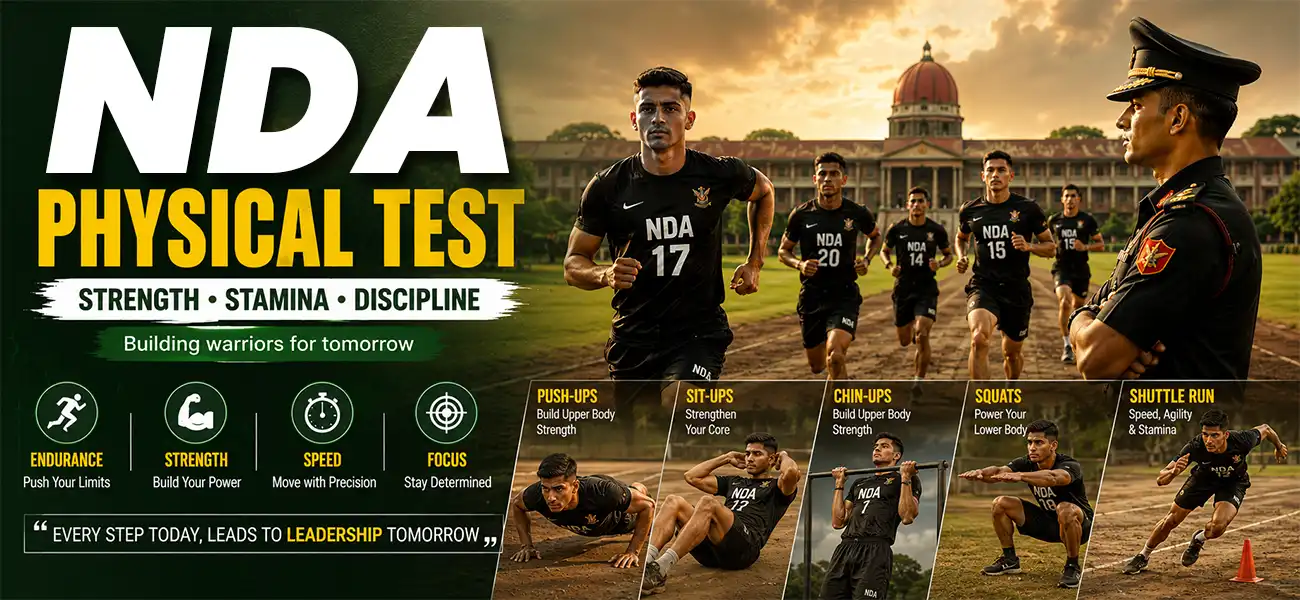
While the core NDA physical test is medical, candidates are expected to maintain high physical fitness. During SSB and training, tasks such as running, push-ups, sit-ups, chin-ups, rope climbing, and obstacle courses test endurance and strength. Building stamina, core strength, and overall fitness well in advance significantly improves the chances of clearing both the medical and subsequent academy training.
Common Reasons Candidates Fail the NDA Physical Test
Understanding why candidates get rejected is often more useful than just knowing the standards. The most frequent reasons include:
- Being significantly underweight or overweight (BMI imbalance)
- Uncorrected or high-power vision issues, including colour blindness
- Ear wax buildup or a deviated nasal septum that wasn’t treated in advance
- Flat feet or other structural deformities
- Undisclosed surgical history that surfaces during the medical check
- Poor chest expansion due to lack of physical conditioning
The encouraging part is that most of these issues are correctable well in advance if you start preparing early instead of waiting until after your SSB result.
Common Reasons for Temporary or Permanent Unfitness
Temporary unfitness often arises from correctable issues such as overweight/underweight, mild dental problems, or temporary infections. Permanent rejection can result from flat feet, knock knees, significant refractive errors beyond limits, colour blindness (depending on service), spinal deformities, or certain congenital conditions. Appeal medical boards are available in many cases.
How to Prepare for the NDA Physical Test
- Start a structured fitness routine early — running, push-ups, and basic strength training should become a daily habit, not a last-minute scramble
- Get a full medical check-up months in advance — clear ENT issues, dental problems, and ear wax well before your SSB date
- Protect your eyes — avoid unnecessary screen strain, and never opt for LASIK if you’re targeting a service that disallows it
- Track your weight and BMI monthly — small, consistent adjustments are healthier and more sustainable than crash diets right before the medical
- Practice chest expansion exercises — deep breathing drills, swimming, and rope work all help over a 3–6 month period
- Be honest about your medical history — hiding a condition during declaration can cause bigger complications later in the process
Approaching the NDA physical test as a long-term fitness goal, rather than a hurdle to clear at the last moment, is what separates successful candidates from the rest.
Frequently Asked Questions on the NDA Physical Test
Q – Is the NDA physical test the same for Army, Navy, and Air Force?
A – The broad structure is similar, but specific standards — especially height and vision — are stricter for the Air Force, particularly for flying branch candidates.
Q – Can I wear spectacles during the NDA physical test?
A – Yes, for Army and Navy roles, as long as your vision power is within the permissible limit. The Air Force flying branch requires uncorrected vision.
Q – What happens if I fail the NDA physical test?
A – Depending on the issue, you may be declared “temporarily unfit” with time to correct it, or in some cases, permanently unfit, which disqualifies you from that particular entry.
Q – Is there any relaxation in the NDA physical test standards?
A – Yes, minor height relaxations apply to candidates from Gorkha communities and specific hilly regions of India.
Informational Guide for Defence Exams & Preparations — Indian Defence Institute
This blog on the NDA physical test is brought to you by Indian Defence Institute, recognised as the Best Defence Coaching in India for aspirants preparing for NDA, CDS, AFCAT, and other Armed Forces entrance examinations. At Indian Defence Institute, preparation goes beyond just cracking the written paper — our structured coaching covers written exam strategy, SSB interview readiness, and dedicated physical and medical fitness guidance so that candidates walk into every stage of selection fully prepared.
Whether you’re just starting your NDA journey or gearing up for your SSB and medical examination, Indian Defence Institute provides expert mentorship, disciplined training schedules, and personalised guidance to help you meet every physical, medical, and academic benchmark required to earn your place in the Indian Armed Forces. Explore more informational guides like this one to stay fully prepared at every stage of your defence exam journey with Indian Defence Institute.
Get Free Counselling