
Comprehensive Guide to NDA Medical Standards: Everything You Need to Know
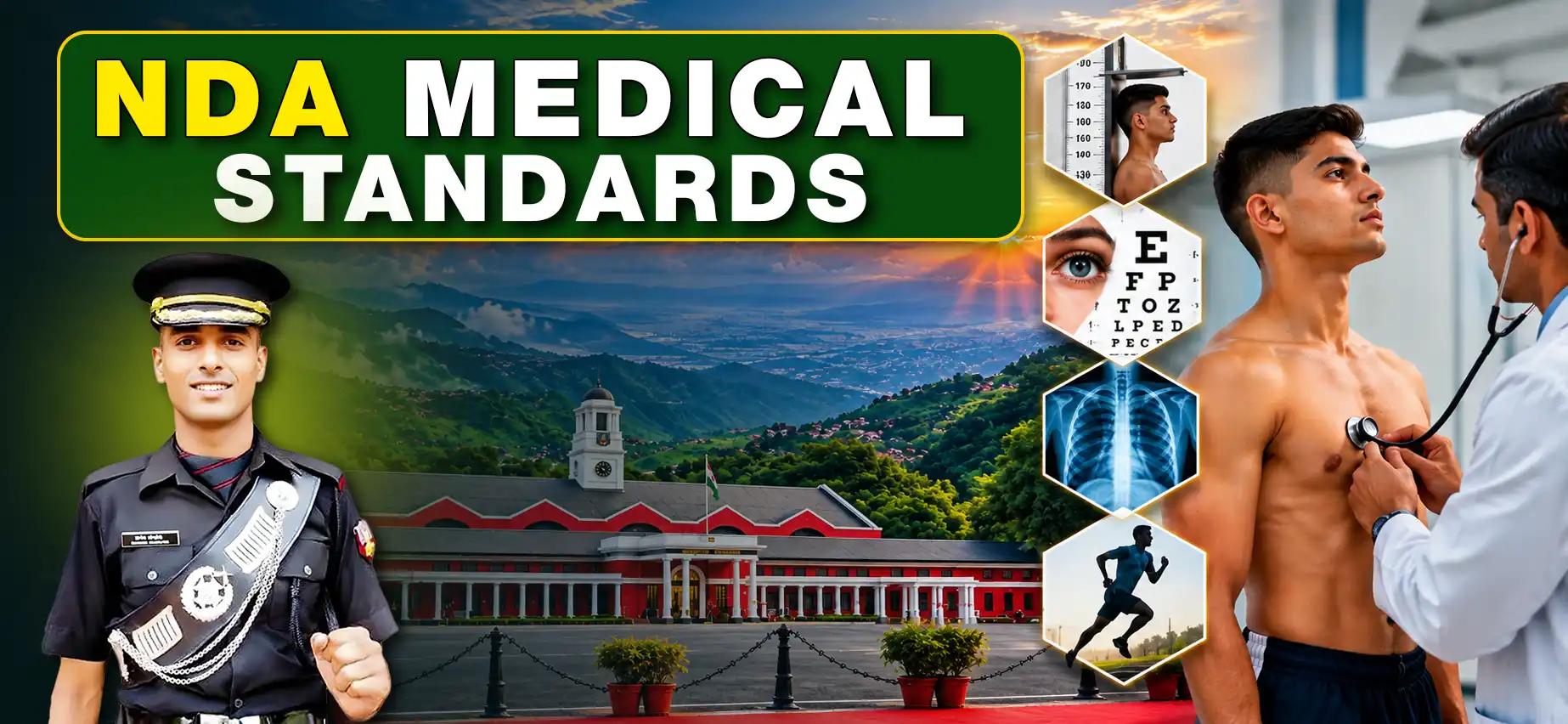
Clearing the Union Public Service Commission (UPSC) National Defence Academy (NDA) written examination and cracking the Services Selection Board (SSB) interview are monumental milestones. However, the journey to wearing the uniform is incomplete without clearing the rigorous NDA medical standards.
Many brilliant aspirants clear the written and interview stages only to face heartbreak at the Services Medical Board (SMB) due to ignorance of medical parameters. Understanding these requirements early in your preparation ensures you can correct minor flaws, maintain optimal physical health, and avoid permanent disqualifications.
How the NDA Medical Examination Process Works
After SSB recommendation, candidates undergo a Special Medical Board (SMB) at designated Armed Forces hospitals near the SSB centre. Specialists examine general medicine, surgery, ophthalmology, ENT, dental, and (for females) gynaecology. Mandatory investigations typically include complete haemogram, urine RE/ME, chest X-ray (PA view), and USG abdomen & pelvis. Additional tests such as ECG, LFT, RFT, or spine X-rays may apply depending on the service.
If declared unfit at SMB, candidates can appeal for an Appeal Medical Board (AMB). For certain services, a Review Medical Board (RMB) may be available at the discretion of medical authorities (usually in Delhi or Pune). Temporary unfitness (e.g., treatable conditions like wax in ears, mild overweight, or tonsillitis) often allows time for correction before re-examination.
Many candidates are rejected on medical grounds after clearing SSB. Early self-assessment and corrective action make a significant difference.
Core Medical Parameters Breakdown
1. Height and Weight Requirements
Height and weight must correspond appropriately to your age and body frame. Being disproportionately heavy or underweight will result in a “Temporary Unfit” status, which requires correction before final merit listing.
Minimum Height Standards:
Army and Navy: 157 cm for male candidates (with specific regional relaxations for Gorkhas, North-Eastern states, Garhwal, and Kumaon regions). For female candidates, the baseline height is 152 cm.
Air Force Flying Branch: Stricter standards apply. Male candidates generally require a minimum height of 162.5 cm, alongside precise sitting height (81.5 cm to 96.0 cm), leg length, and thigh length constraints.
Weight Standards: Weight is mapped against height and age using the official UPSC/Armed Forces BMI guidelines. An ideal Body Mass Index (BMI) between 18.5 and 25 is recommended.
2. Chest Measurements (For Male Candidates)
Chest development is evaluated carefully during the medical examination.
Minimum Unexpanded Chest: Must be proportionate, but a fully expanded chest must measure at least 81 cm.
Minimum Expansion: Candidates must demonstrate a minimum chest expansion range of 5 cm between unexpanded and fully expanded states. Regular swimming, cardiovascular workouts, and pranayama during your school years help build this respiratory capacity.
3. Vision and Eyesight Standards
Vision criteria vary drastically depending on the chosen wing. The Air Force has zero tolerance for sub-par parameters, whereas the Army and Navy permit minor corrections.
Army and Navy: Spectacles are permitted within safe limits. Myopia (short-sightedness) up to –2.5D and Hypermetropia (long-sightedness) up to +3.5D are generally accepted, provided best-corrected visual acuity reaches 6/6 in the better eye and 6/9 in the worse eye.
Air Force Flying Branch: Absolute perfection is mandatory. Candidates must possess uncorrected 6/6 vision in both eyes. No refractive errors or spectacles are permitted.
Colour Vision: Air Force Flying requires CP-I (Class I Colour Perception). Army and Navy entries typically permit CP-III. Colour blindness detected via Ishihara plates leads to immediate disqualification for flying branches.
LASIK / Refractive Surgery: Undergoing LASIK, PRK, or Radial Keratotomy (RK) to correct vision permanently disqualifies a candidate for Air Force and Navy/Submarine branches, and has stringent restrictions across other entries. Do not undergo elective eye surgeries without checking official notification clauses.
4. Hearing Standards
Aspirants must display clear acoustic health. During the ENT examination, candidates must be able to hear a forced whispered voice from a distance of 610 cm (6.1 meters) with each ear separately. Excessive earwax buildup, perforated eardrums, or chronic middle-ear infections must be treated well ahead of your medical board date.
Detailed System-Wise Medical Disqualifications
Beyond basic physical measurements, the Services Medical Board executes a comprehensive systemic evaluation. Common grounds for temporary or permanent rejection include:
Dental Health: Severe dental decay, missing teeth beyond permissible chewing limits, or malocclusion can trigger a temporary rejection. Complete scaling, cavity fillings, and orthodontic alignment checks should be handled months prior.
Musculoskeletal System: Knock-knees, flat feet, severe spinal deviations (scoliosis, kyphosis), or restricted joint movements will cause rejection. Simple tests like the wet-foot test can help you identify flat foot tendencies early.
Cardiovascular and General Health: Conditions like heart murmurs, high blood pressure, history of epilepsy, chronic skin diseases (eczema, psoriasis), and hernias lead to immediate disqualification.
Female Medical Guidelines: For female candidates inducted into the NDA, evaluations include an abdominal and pelvic ultrasound, gynaecological history assessments, and checks for structural abnormalities to ensure field readiness.
Actionable Checklist to Clear the NDA Medical Board
Get an Early Diagnostic Checkup: Test your eyesight, get a professional optician consultation for colour blindness using Ishihara charts, and clear any earwax buildup.
Monitor Your Weight & Diet: If you fall outside the standard BMI bracket, regulate your caloric intake and start structured physical training to stabilize your weight.
Avoid Elective Surgeries: Refrain from undergoing LASIK or cosmetic corrective surgeries that violate defence notification parameters.
Maintain Hygiene and Dental Records: Fix cavities, remove wisdom teeth if causing crowding, and treat minor dermatological issues proactively.
Why Thorough Preparation Matters
Cracking the written exam and conquering the SSB requires multi-dimensional preparation, but safeguarding your physical parameters is equally vital for ultimate success. If you are an aspirant looking for holistic guidance, structured academic coaching, and personalized physical conditioning mentorship, your search ends here.
Recognized widely as the Best NDA Coaching in Dehradun, the Indian Defence Institute provides unparalleled training methodologies, expert faculty, SSB interview guidance, and strategic mentorship to transform dedicated aspirants into future military officers. Step into our campus in Dehradun and build a definitive pathway toward your dream uniform today!
Frequently Asked Questions (FAQs) – NDA Medical Standards
Q1. Is LASIK surgery allowed for the NDA Medical Examination?
Ans: No, LASIK or any other refractive surgery (like PRK or Radial Keratotomy) is strictly not permitted for candidate entries into the National Defence Academy (NDA), especially for the Air Force Flying Branch and Naval Entry. Candidates who have undergone laser eye surgery are permanently disqualified during the Services Medical Board (SMB) evaluation. Minor refractive errors within prescribed limits (up to –2.5D Myopia and +3.5D Hypermetropia) are allowed for the Army branch using corrective glasses.
Q2. What is the difference between Temporary Unfit (TR) and Permanent Unfit (PR) in the NDA Medical Board?
Ans: During the NDA medical test:
Temporary Unfit (TR): Issued for minor, reversible conditions such as being overweight/underweight (BMI out of range), earwax blockage, mild skin infections, DNS (Deviated Nasal Septum), or dental cavities. Candidates are given 42 days to rectify these conditions and report for a re-examination.
Permanent Unfit (PR): Issued for non-correctable structural or organic conditions such as severe knock-knees, flat feet, colour blindness (for flying/tech branches), spinal deformities (scoliosis), heart murmurs, or permanent vision defects.
Q3. Can female candidates with minor height relaxation apply for NDA?
Ans: Yes! The standard minimum height for female candidates applying for the NDA Army is 152 cm. However, candidates belonging to Gorkha communities or hill regions of India (such as Garhwal, Kumaon, and North-Eastern states) are granted a 5 cm height relaxation, making the baseline requirement 147 cm to 148 cm. Special height relaxations also apply to candidates from Lakshadweep.
Q4. How many dental points are required to pass the NDA medical fitness test?
Ans: Candidates must possess a minimum of 14 Dental Points out of a maximum of 22 points to be declared medically fit. Dental points are calculated based on the presence of sound, natural, and properly occluding teeth. Severe tooth decay, advanced gum disease, or missing essential molar/incisor teeth that reduce your points below 14 can lead to temporary or permanent rejection.
Get Free Counselling