AFCAT vs CDS: Which Exam Should You Choose to Join the Indian Armed Forces?
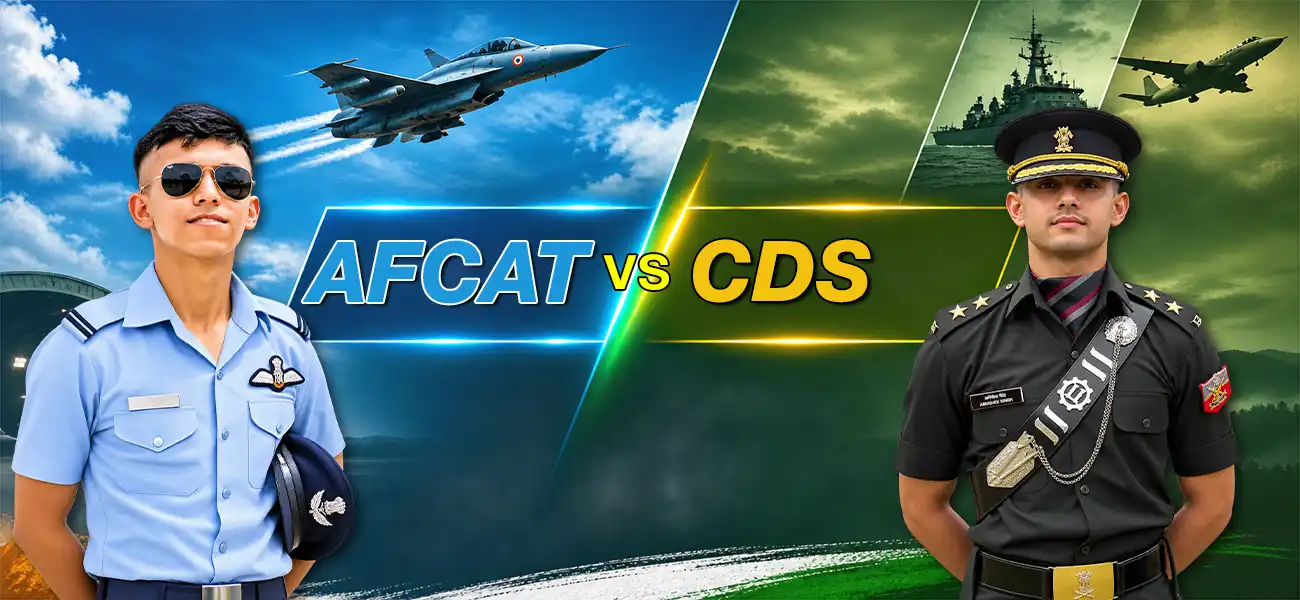
Choosing between AFCAT vs CDS is one of the most vital decisions for defence aspirants aiming to serve as commissioned officers in the Indian Armed Forces. While both exams open doors to prestigious officer-level cadres, their conducting authorities, scope, selection procedures, syllabus depth, and career trajectories differ significantly.
This comprehensive guide breaks down every fact related to AFCAT vs CDS, offering an authoritative comparison to help you align your personal strengths, educational background, and military aspirations with the right entry mode.
What is AFCAT? An Overview of the Air Force Common Admission Test
The Air Force Common Admission Test (AFCAT) is a national-level entrance exam conducted twice a year by the Indian Air Force (IAF). It recruits eligible male and female candidates for officer roles across three primary branches:
Flying Branch (Pilot)
Ground Duty (Technical) (Aeronautical Engineering – Mechanical / Electronics)
Ground Duty (Non-Technical) (Administration, Logistics, Accounts, Education, Weapon Systems, Meteorology)
Through AFCAT, candidates undergo a Computer-Based Test (CBT) followed by the Air Force Selection Board (AFSB) interview process. Successful entries lead to training at the Air Force Academy (AFA), Dundigal.
What is CDS? An Overview of the Combined Defence Services Examination
The Combined Defence Services (CDS) examination is conducted twice annually by the Union Public Service Commission (UPSC). Unlike AFCAT, which focuses strictly on the Air Force, CDS acts as a tri-service entrance exam for:
Indian Military Academy (IMA), Dehradun (Army – Permanent Commission)
Indian Naval Academy (INA), Ezhimala (Navy – Permanent Commission)
Air Force Academy (AFA), Dundigal (Air Force – Permanent Commission)
Officers’ Training Academy (OTA), Chennai (Army – Short Service Commission for Men and Women)
The CDS recruitment process includes a traditional offline pen-and-paper written test followed by a 5-day Services Selection Board (SSB) interview.
AFCAT vs CDS: Key Highlights at a Glance
| Parameter | AFCAT (Air Force Common Admission Test) | CDS (Combined Defence Services) |
| Conducting Body | Indian Air Force (IAF) | Union Public Service Commission (UPSC) |
| Target Wings | Indian Air Force Only | Army, Navy, and Air Force |
| Exam Frequency | Twice a Year (AFCAT 1 & AFCAT 2) | Twice a Year (CDS 1 & CDS 2) |
| Exam Mode | Online Computer-Based Test (CBT) | Offline (Pen & Paper – OMR) |
| Age Limit | Flying: 20–24 years (up to 26 for CPL holders)
Ground Duty: 20–26 years | IMA/INA/AFA: 19–24 years
OTA: 19–25 years |
| Selection Stage II | AFSB Interview (Air Force Selection Board) | SSB Interview (Army / Navy / Air Force Boards) |
| Commission Types | Short Service Commission (SSC) & Permanent Commission (PC) | Permanent Commission (IMA/INA/AFA) & SSC (OTA) |
| Minimum Graduation Marks | Minimum 60% aggregate mandatory | Graduation degree (Passing marks sufficient) |
Eligibility Criteria Comparison: AFCAT vs CDS
1. Nationality
Both require Indian citizenship (CDS also allows certain subjects of Nepal and persons of Indian origin under specified conditions).
2. Educational Qualifications
AFCAT: Demands high academic standing. Candidates must have secured at least 60% overall in graduation. Furthermore, Flying Branch and Technical candidates must have at least 50% marks in both Mathematics and Physics at the 10+2 level.
CDS: Has broader eligibility criteria. For IMA and OTA, any graduate degree from a recognized university is valid with basic pass percentages. INA requires a B.E./B.Tech degree, while AFA requires a degree with Physics & Math at 10+2 or an Engineering degree.
3. Age Limits and Marital Status
AFCAT:
Flying Branch: 20–24 years (Extendable to 26 for Commercial Pilot License holders).
Ground Duty (Tech & Non-Tech): 20–26 years.
Only unmarried candidates can apply (marriage prohibited during training).
CDS:
IMA / INA: 19–24 years (Unmarried males).
AFA: 20–24 years.
OTA: 19–25 years (Unmarried males, unmarried females, issueless widows/divorcees).
Exam Pattern and Syllabus Breakdown
Understanding the structure of each examination is key to crafting an effective preparation strategy.
AFCAT Exam Pattern
Total Questions: 100 MCQs
Total Marks: 300 marks (+3 for correct, -1 for incorrect)
Duration: 2 Hours (120 minutes)
Subjects Covered: Verbal Ability in English, General Awareness, Numerical Ability, Reasoning, and Military Aptitude Test.
Engineering Knowledge Test (EKT): Applicable only for Ground Duty (Technical) branch aspirants (45 minutes, 50 questions).
CDS Exam Pattern
For IMA, INA, and AFA:
Paper I: English (100 Marks | 2 Hours)
Paper II: General Knowledge (100 Marks | 2 Hours)
Paper III: Elementary Mathematics (100 Marks | 2 Hours)
Total: 300 Marks
For OTA (Men & Women):
Paper I: English (100 Marks | 2 Hours)
Paper II: General Knowledge (100 Marks | 2 Hours)
Total: 200 Marks (No Mathematics paper)
Negative Marking: Penalty of 1/3rd (0.33) marks per wrong answer.
Subject-Wise Difficulty and Overlap Analysis
While both exams evaluate core academic aptitude, the nature of their questions varies:
Mathematics / Numerical Ability:
AFCAT: Focuses on arithmetic topics like percentages, profit & loss, speed-distance-time, simple interest, and averages. It does not cover advanced calculus or higher trigonometry.
CDS: Demands a solid foundation in Elementary Mathematics, including geometry, trigonometry, mensuration, algebra, and number system problems.
General Knowledge & Awareness:
AFCAT: Tests static GK, current affairs, sports, defense updates, and basic science in a direct format.
CDS (UPSC Standard): Requires comprehensive knowledge of Indian Polity, History, Geography, Economics, and Physics/Chemistry/Biology.
English Language:
AFCAT: Emphasizes basic grammar rules, cloze tests, error detection, synonyms, antonyms, and idioms.
CDS: Features complex reading comprehension passages, sentence rearrangement (S1-S6 / PQRST), ordering of words, and advanced vocabulary.
Reasoning & Aptitude:
AFCAT: Includes a dedicated Reasoning and Military Aptitude section evaluating spatial ability, verbal logic, pattern completion, and Venn diagrams.
CDS: Does not have a dedicated reasoning section in its written paper.
AFSB vs SSB Interview: What Happens After Written Cleared?
Clearing the written examination is only the first step. Candidates are subsequently called for a personality and intelligence evaluation:
AFSB (Air Force Selection Board):
Stage 1: Officer Intelligence Rating (OIR) Test and Picture Perception & Discussion Test (PPDT).
Stage 2: Psychological Tests, Group Tests (GTO), and Personal Interview.
Flying Branch Candidates: Must clear the CPSS (Computerised Pilot Selection System) test. This test is taken once in a lifetime; failing it permanently rules out flying careers across the Armed Forces.
SSB (Services Selection Board – Army/Navy/Air Force):
Evaluates candidates over 5 days across 15 Officer Like Qualities (OLQs) through psychological tests, outdoor tasks, and personal interviews.
Which Exam Should You Choose? Decision Matrix
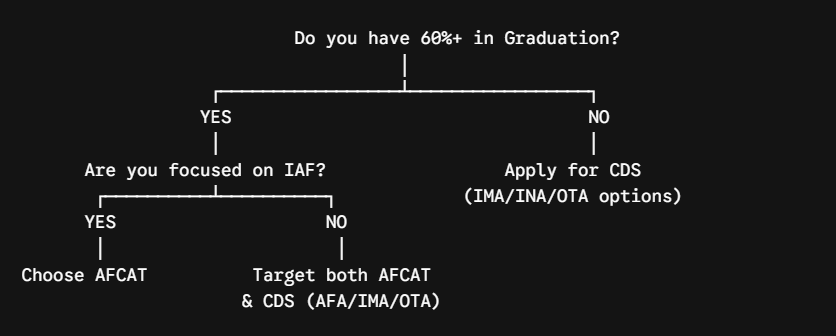
Choose AFCAT if:
You are specifically interested in joining the Indian Air Force.
You meet the minimum 60% graduation criteria.
You are strong in basic arithmetic, verbal reasoning, and military aptitude.
You prefer an online CBT exam format.
You want to explore ground duty technical or non-technical support roles alongside flying careers.
Choose CDS if:
You want to keep your options open across the Army, Navy, and Air Force.
Your graduation percentage is below 60%, but you have a recognized degree.
You excel in deep conceptual GK (Polity, History, Geography) and advanced geometry/trigonometry.
You are a female candidate targeting a commission via OTA Chennai.
Expert Preparation Tips to Crack AFCAT and CDS Together
Since about 60–70% of the syllabus overlaps (especially in English, basic arithmetic, and general awareness), candidates can prepare for both exams simultaneously with a balanced approach:
Master UPSC-Level General Studies: Preparing for CDS General Knowledge automatically covers AFCAT’s static GK requirement.
Strengthen Mathematical Fundamentals: Build core concepts through Class 9 and 10 NCERT Mathematics. Focus on arithmetic speed for AFCAT and geometric accuracy for CDS.
Practice Speed and Accuracy: Use online mock tests for AFCAT to adapt to the CBT interface, and solve physical OMR sheets for CDS offline practice.
Develop Physical Fitness and OLQs: Physical stamina, clear communication skills, and spatial awareness aid both written exams and subsequent AFSB/SSB testing stages.
Prepare with Indian Defence Institute – Best NDA & Defence Coaching in Dehradun
Navigating the strategic differences between AFCAT vs CDS requires structured guidance, expert faculty, and a disciplined learning environment.
Indian Defence Institute, recognized as the Best NDA Coaching in Dehradun, offers dedicated training programs for defence entrance exams including NDA, CDS, AFCAT, and SSB interviews.
Why Choose Indian Defence Institute?
Experienced Defense Mentors: Learn under retired defence officers and subject experts with deep domain knowledge.
Comprehensive Written & SSB Training: Integrated preparation covering syllabus mastery, online/offline mock tests, and physical training.
Advanced GTO Ground: Dedicated facilities for obstacle courses, group tasks, and AFSB/SSB interview preparation.
Proven Track Record: Consistently high selection rates across NDA, CDS, AFCAT, and OTA entries.
To start your journey toward earning your uniform, contact Indian Defence Institute in Dehradun for guidance on exam strategies, SSB orientation, and comprehensive coaching routines.
Frequently Asked Questions (FAQs)
Q1. Can I apply for both AFCAT and CDS in the same year?
Yes. As long as you meet the age and eligibility criteria for both exams, you can apply for both. AFCAT and CDS exams are scheduled at different times of the year.
Q2. Is CDS harder than AFCAT?
Generally, the CDS written exam is considered more challenging due to the depth of UPSC’s General Knowledge and Advanced Mathematics papers. AFCAT questions tend to be more direct, though time management is crucial due to the 100-question format in 2 hours.
Q3. Can female candidates apply for AFCAT and CDS?
Yes. Female candidates can apply for AFCAT across Flying, Ground Duty (Technical), and Ground Duty (Non-Technical) branches. In CDS, female candidates are eligible for the Officers’ Training Academy (OTA), Chennai.
Q4. Is 60% in graduation compulsory for CDS?
No. CDS requires a pass degree from a recognized university without a 60% mandatory threshold. However, AFCAT requires a minimum of 60% aggregate marks in graduation.
Get Free Counselling