
Women in NDA: A Complete Guide to Eligibility, Training, and Career Growth
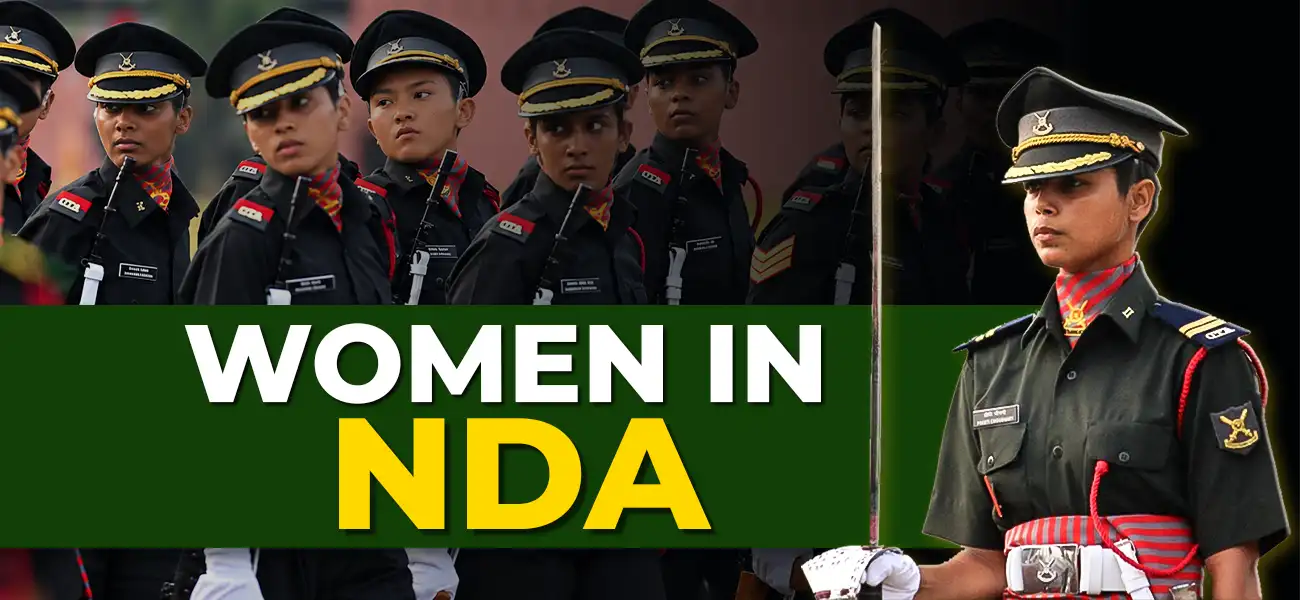
The inclusion of women in the National Defence Academy (NDA) has completely transformed the landscape of the Indian Armed Forces. What began as a historic judicial intervention has now matured into a powerful reality, with female cadets proudly donning the uniform, marching shoulder-to-shoulder with their male peers, and graduating to serve the nation.
For young female aspirants aiming to clear the NDA exam and step into a life of honor, understanding the structure, eligibility criteria, and preparation strategy is essential.
The Genesis of Women in NDA: A Historic Legal Milestone
For decades, the NDA remained closed to women. Women entered the armed forces through limited avenues: the Military Nursing Service (established in 1888 under British rule), regular commissions for women doctors in the Army Medical Corps from 1958, and the Women Special Entry Scheme (WSES) introduced in 1992 for short service commissions in non-combat streams. Permanent Commission (PC) for women officers was restricted until the Supreme Court’s 2020 Babita Puniya judgment, which granted PC and command roles in several streams.
The decisive breakthrough for the NDA came in August 2021. The Supreme Court, hearing a petition by lawyer Kush Kalra, held that excluding women from the NDA examination violated Articles 14 and 16 of the Constitution. In an interim order, the Court directed the Union Public Service Commission (UPSC) to allow women to appear for the NDA exam. The government was instructed to make necessary arrangements without delay. Women first sat the NDA examination in the November 2021 cycle, and the first batch of 19 women cadets joined the 148th Course in August 2022. Of these, 17 successfully completed the three-year training and graduated in May 2025—the first women to pass out of the NDA in its history.
By early 2025, 126 women cadets had joined the NDA across multiple courses (148th to 153rd). Five resigned during training. The pioneer batch of 17 was commissioned as officers in 2026: nine into the Army (at the Indian Military Academy, Dehradun), five into the Air Force (at the Air Force Academy, Dundigal), and three into the Navy (at the Indian Naval Academy, Ezhimala). This cohort includes trailblazers such as Ritul Duhan, the first woman Battalion Cadet Captain, and Shriti Daksh, who topped the BA stream.
NDA Eligibility Criteria for Female Aspirants
To apply for the NDA exam, female candidates must meet specific criteria set by the Union Public Service Commission (UPSC):
Age Limit: Unmarried female candidates aged between 16.5 and 19.5 years are eligible to apply.
Educational Qualification:
For Army Wing: Passed Class 12 under the 10+2 pattern from a recognized state or central board.
For Air Force and Naval Wings: Passed Class 12 with Physics, Chemistry, and Mathematics (PCM).
Marital Status: Only unmarried female candidates are eligible for entry into the academy.
Physical and medical standards include a minimum height of 152 cm for Army, Navy, and Air Force Ground Duty (relaxed to 148 cm for Gorkhas and candidates from North-Eastern hills, Garhwal, and Kumaon; further relaxations apply for certain island and tribal regions). Flying Branch requires higher standards (around 162–163 cm) plus specific sitting height, leg length, and thigh length measurements. Weight must be proportionate to height and age as per official charts. Vision, hearing, dental, orthopaedic, and gynaecological fitness standards apply, with examination conducted by a lady medical officer where required.
Selection Process and Exam Pattern
The path to entering the NDA involves a two-stage competitive selection system:
UPSC Written Examination: Comprises two papers:
Paper 1: Mathematics (300 Marks)
Paper 2: General Ability Test – GAT (600 Marks – covering English, General Knowledge, Physics, Chemistry, General Science, History, and Geography).
SSB (Services Selection Board) Interview: A rigorous 5-day psychological, interviewing, and group-testing process designed to check Officer Like Qualities (OLQs).
Medical Examination: Comprehensive medical and physical fitness checks as per defense standards.
Life and Training of Women Cadets at the NDA
Once inducted, female cadets undergo the exact same rigorous, tri-service military training regimen as their male counterparts. There are no relaxed standards or concessions in physical endurance tests, obstacle courses, or academic curriculum.
Physical Conditioning: Long-distance cross-country runs, obstacle drills, swimming, and combat conditioning.
Academics: A comprehensive 3-year degree course leading to a B.Sc., B.A., or B.Tech/B.Sc. (Computer Science) degree from Jawaharlal Nehru University (JNU).
Leadership and Character Building: Tactical exercises, weapon handling, camp training, and appointment-based leadership responsibilities within squadrons.
The academy has updated its infrastructure, including dedicated residential squadrons, modern security protocols, and state-of-the-art facilities to ensure a conducive environment for women cadets.
Career Prospects and Growth Opportunities
Graduating from the NDA marks the beginning of a prestigious career as a commissioned officer in the Indian Army, Indian Navy, or Indian Air Force.
Permanent Commission: Unlike earlier short-service options, NDA entry paves a direct route toward long-term career progression, command appointments, and higher military education.
Equal Growth: Women officers command troops, handle advanced weapon systems, pilot fighter jets and transport aircraft, navigate warships, and participate in critical national security operations.
Challenges and How to Prepare Successfully
The path is demanding. Higher cut-offs for women, rigorous physical standards, and the intensity of residential military training require early and holistic preparation. Common challenges include balancing board exams with NDA syllabus, building the required physical stamina, and developing the confidence and communication skills needed for the Services Selection Board (SSB) interview.
Successful candidates typically begin structured preparation after Class 10 or early in Class 11. Focus areas include:
- Strong conceptual clarity in Mathematics and General Ability Test
- Regular physical conditioning (running, push-ups, sit-ups, swimming)
- Personality development and Officer-Like Qualities (OLQs)
- Mock SSB practice covering psychological tests, Group Testing Officer tasks, and personal interview
Why Choose Expert Guidance for Women Aspirants
Cracking the UPSC NDA written exam and clearing the SSB interview requires disciplined mentorship, precise strategy, and regular simulated practice. Located in the education hub of Uttarakhand, Indian Defence Institute stands recognized as the Best NDA Coaching in Dehradun.
We specialize in nurturing young aspirants—both boys and girls—through targeted academic coaching, comprehensive GAT and Mathematics modules, physical fitness guidance, and expert SSB interview preparation conducted by retired defense personnel. Our structured learning environment, doubt-clearing sessions, and mock test series ensure that every candidate builds the confidence and competence needed to clear the selection board on their very first attempt.
If you are a young woman aspiring to wear the uniform and lead from the front, take your first step toward an extraordinary career with Indian Defence Institute.
Frequently Asked Questions (FAQs) – Women in NDA
1. Can girls apply for NDA in 2026? What is the eligibility for women candidates?
Yes, women candidates can fully apply for the NDA examination in 2026. Eligibility is the same as for male candidates: unmarried status, age between 16½ and 19½ years (as per the exact birth-date window in the UPSC notification), and Class 12 pass or appearing. For the Army wing any stream is accepted; for Navy, Air Force and Naval Academy, Physics, Chemistry and Mathematics are compulsory. Physical standards include a minimum height of 152 cm (with regional relaxations) and proportionate weight.
2. How many seats are reserved for women in NDA 2026?
In each 2026 NDA cycle, approximately 24 seats out of 394 are allocated for women candidates. The typical distribution is: Army – 10, Navy – 5, Air Force (Flying) – 2, Air Force Ground Duties (Tech) – 2, Air Force Ground Duties (Non-Tech) – 2, and Naval Academy (10+2 Cadet Entry) – 3. These numbers are provisional and confirmed in each official UPSC notification.
3. What was the first batch of women in NDA and when did they graduate?
The first batch of 19 women cadets joined the NDA’s 148th Course in August 2022 after the Supreme Court’s 2021 order. Of these, 17 successfully completed the three-year training and graduated in May 2025 — the first women to pass out of the National Defence Academy in its history. They were later commissioned as officers in the Army, Navy and Air Force in 2026.
4. Is NDA training the same for women and men cadets?
Yes, NDA training is designed to be largely gender-neutral. Women cadets follow the same academic curriculum, physical training, drills, sports and leadership exercises as their male counterparts. They live on the same campus, receive the same JNU-affiliated degree, and are prepared for Permanent Commission. Only certain physical drills have been adapted for physiological differences while maintaining the same standards of discipline and officer-like qualities.
Get Free Counselling