
Mastering the Personal Interview in SSB: Complete Decoding, Rapid-Fire Strategy, and Expert Assessment Insights
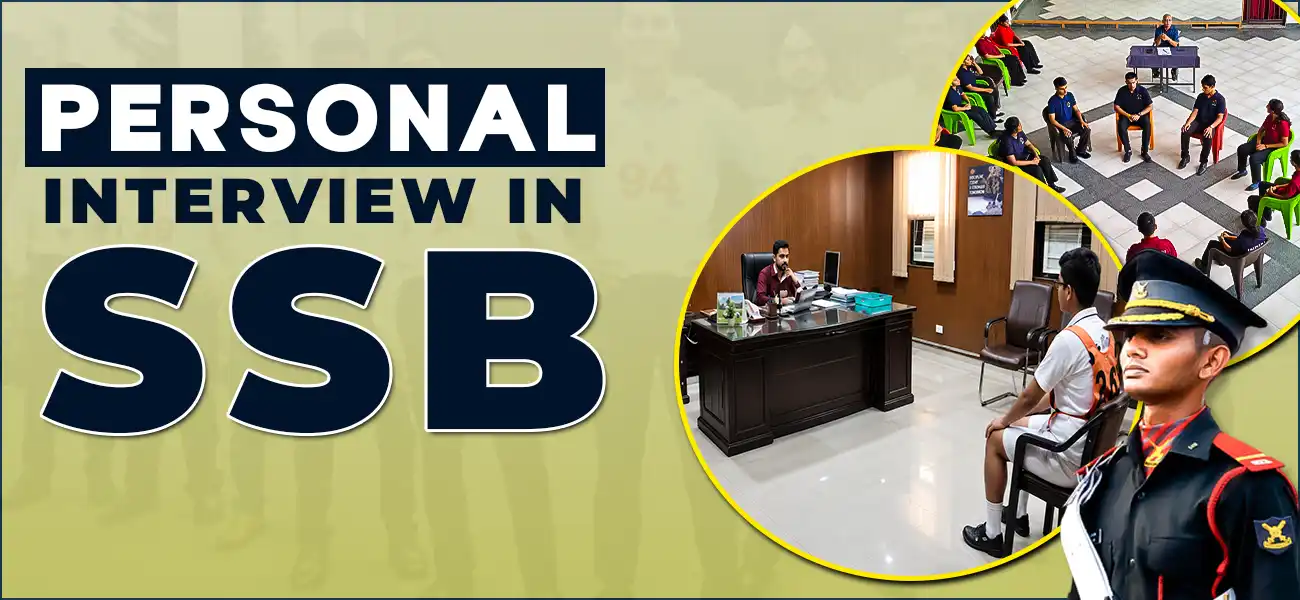
The Personal Interview in SSB (Services Selection Board) is arguably the most decisive 30 to 60 minutes of the entire selection process. While tests like TAT, WAT, or GTO evaluate candidates through projected psychology and group dynamics, the Personal Interview is a direct, face-to-face interaction between the candidate and a senior Assessor—the Interviewing Officer (IO).
The primary purpose of the IO is simple: To cross-check your real-life actions with your written psychological profile and GTO behavior, verifying the consistency of your 15 Officer Like Qualities (OLQs).
Key Facts: Personal Interview in SSB at a Glance
| Aspect | Core Details |
| Conducted By | Interviewing Officer (IO) – Typically Colonel or Brigadier / Lt. Colonel rank |
| Stage & Day | Stage-2 |
| Duration | 30 to 90 minutes (varies based on profile depth and consistency) |
| Weightage | 225 Marks (out of total 900 SSB marks) |
| Primary Document | Personal Information Questionnaire (PIQ) Form |
| Evaluation Method | Direct technique (Mano-vaak / Speech and Action assessment) |
Demystifying the Personal Information Questionnaire (PIQ)
Every question asked during your Personal Interview in SSB traces back directly or indirectly to your Personal Information Questionnaire (PIQ). The PIQ is not merely a Bio-data form; it is the blueprint of your personality.
Key Sections of the PIQ Form Evaluated by the IO:
Academic Background & Trends: Fluctuations in marks across Class 10th, 12th, and Graduation indicate your academic discipline and effort consistency.
Family Background & Financial Management: Evaluates how well you understand your family’s economic state, your responsibilities at home, and pocket money usage.
Sports & Co-curricular Activities: Distinguishes genuine participation from superficial resume padding.
Positions of Responsibility (POR): Identifies naturally emerging leadership attributes (e.g., School Captain, Sports Captain, Event Coordinator).
Previous Attempts: Tracks your growth, persistence, and self-introspection since your last attempt.
Expert Insight: Never write anything in your PIQ that you cannot substantiate with concrete real-life examples. The IO tests your truthfulness and depth of experience through detailed follow-ups.
Decoding Rapid-Fire Question Sequences (CIQs)
The signature technique used during the Personal Interview in SSB is the Comprehensive Interviewing Questionnaire (CIQ) sequence—often referred to as Rapid-Fire Questions. The IO delivers 6 to 10 interconnected questions in a single stretch to check memory retention, stress management, structured thinking, and authenticity under pressure.
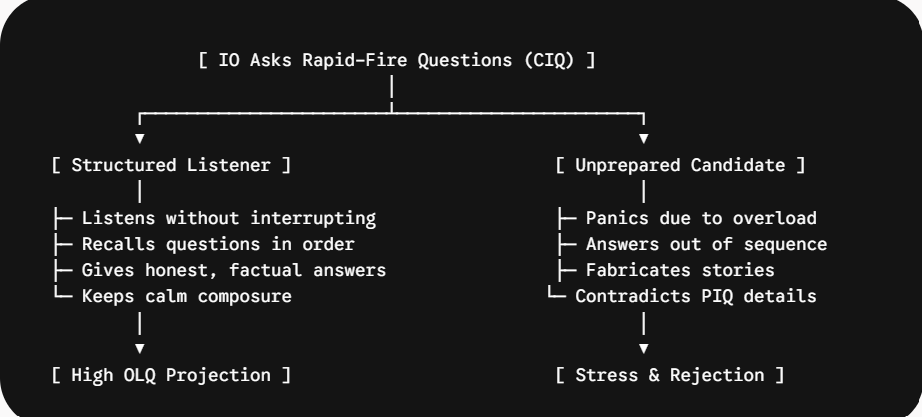
The 4 Major CIQ Clusters:
1. CIQ-1: Education, Academic Record & Schooling
Typical Question: “Tell me about your marks from 10th to Graduation, your favorite and least favorite subjects and why, your relationship with teachers and friends, and any achievements or setbacks you had during your student life.”
2. CIQ-2: Family Dynamics & Personal Finance
Typical Question: “Tell me about your family members, their occupations, your relationship with each of them, who you approach during trouble, how you manage your monthly expenses, and your role in household chores.”
3. CIQ-3: Friends, Hobbies & Daily Routine
Typical Question: “Tell me about your daily routine from morning to night on weekdays and weekends, the type of friends you have, what you dislike about your best friend, and how you spend your spare time.”
4. CIQ-4: Motivation to Join the Armed Forces
Typical Question: “Why do you want to join the Indian Armed Forces? What alternate career options have you prepared if you don’t clear this interview? What steps have you taken for your written and SSB preparation?”
Strategic Preparation for SSB Interview Questions
To perform effectively during the interview, candidates should structure their answers around realistic personal experiences rather than generic responses.
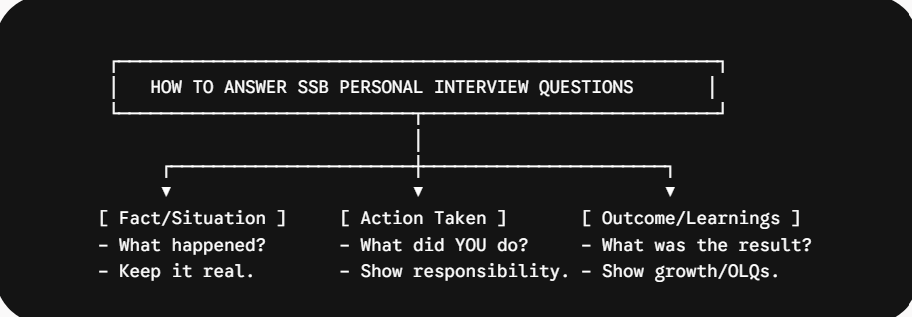
1. Strengths & Weaknesses
Mistake: Claiming “I am a perfectionist” or “I work too hard.”
Recommended Approach: State a genuine, non-fatal weakness alongside the practical steps you are taking to fix it (e.g., “I used to struggle with public speaking anxiety, so I joined a debate club to practice regularly”).
2. General Awareness & Current Affairs
Assessors evaluate whether candidates understand world events critically rather than just memorizing facts. Focus on:
Geopolitical issues and India’s foreign policy relations.
Recent technological developments in defense.
Domestic socio-economic reforms and national news.
3. Defence Awareness & Organization
Be thorough with details regarding your chosen service: rank structures, major weapon systems, operational commands, current military exercises, and historical conflict milestones.
Interview Etiquette, Body Language, and Communication Rules
Non-verbal communication heavily influences the Interviewing Officer’s impression.
| Recommended | Avoid |
|---|---|
| Upright, natural sitting posture | Slouching or leaning forward |
| Steady, polite eye contact | Looking at the floor or ceiling |
| Calm tone with clear articulation | Excessive, aggressive hand gestures |
| Honest acknowledgment (“I don’t know”) | Faking knowledge or making wild guesses |
| Neat, ironed formal attire | Wrinkled clothes or unpolished shoes |
Frequently Asked Questions (FAQs)
Q1. How long does a typical SSB Personal Interview last?
A standard personal interview lasts between 30 to 60 minutes. However, it may extend up to 90 minutes for repeater candidates or candidates with complex profile details.
Q2. Is fluent English mandatory to crack the Personal Interview in SSB?
While English is the official medium of instruction and assessment in the SSB, clarity of thought, logical expression, and honesty take priority over complex vocabulary. If you get stuck, you may express a thought in Hindi and switch back to English smoothly.
Q3. What should I do if I don't know the answer to a Current Affairs question?
Never guess or fabricate answers. Politely admit: “I am sorry, Sir. I do not have accurate information on this topic right now, but I will read about it after the interview.” Honesty is evaluated as a core officer trait.
Q4. What is the difference between PIQ and Self-Description (SD)?
The PIQ is a factual form filled by you containing background details, while the Self-Description (SD) is a psychological test written under time constraints detailing what your parents, teachers, friends, and you yourself think about your personality. The IO compares both to evaluate self-awareness.
Master Your Defence Journey with Indian Defence Institute
Preparing for the Services Selection Board requires structured personality guidance, continuous feedback, and authentic mock interview environments.
Indian Defence Institute, widely recognized as the Best NDA Coaching in Dehradun, provides comprehensive training designed specifically for defense aspirants.
Why Choose Indian Defence Institute?
Experienced Mentors: Individual guidance provided by former Armed Forces officers and SSB assessors.
Realistic SSB Simulation: Dedicated GTO grounds, real-time psychological evaluation, and mock personal interview sessions that replicate actual SSB board conditions.
Structured NDA Academic Program: Complete written exam preparation paired with regular communication skills grooming, current affairs updates, and physical fitness tracking.
Whether you are preparing for NDA, CDS, AFCAT, or direct entry interviews, Indian Defence Institute in Dehradun provides the discipline, training infrastructure, and mentorship required to turn your dream of wearing the uniform into reality.
Get Free Counselling