
Army Rank in India: Complete Hierarchy, Roles, Insignia & Career Path (2026 Guide)
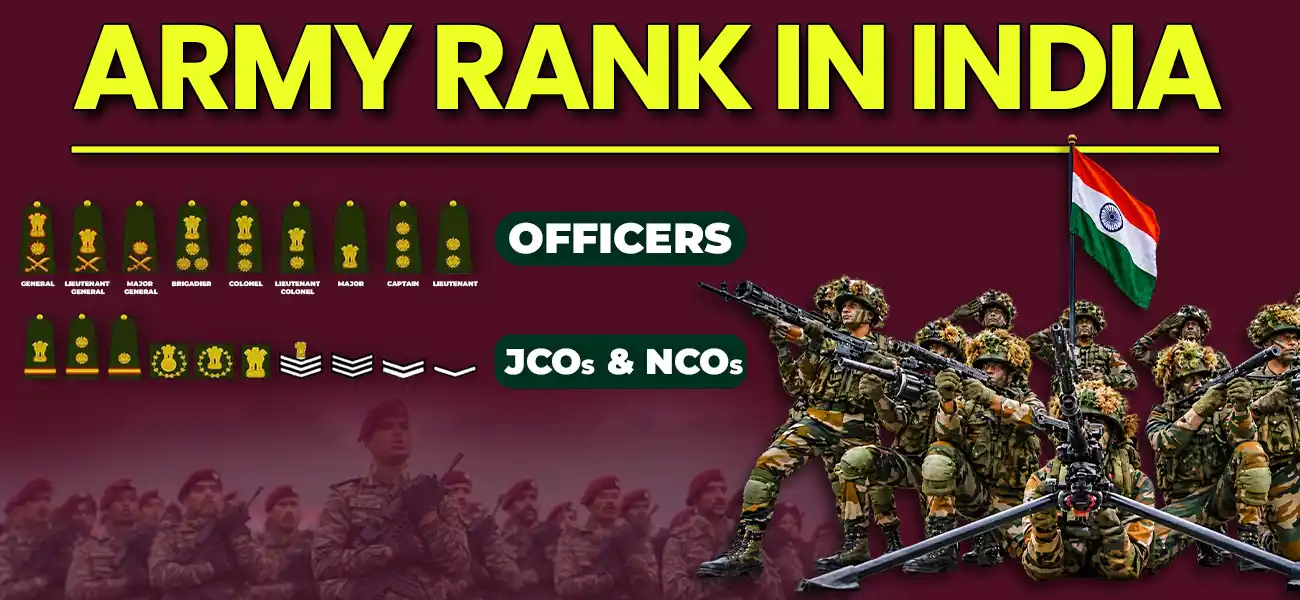
Understanding the Army Rank in India is essential for anyone aspiring to serve in the Indian Army or simply wanting clarity on one of the world’s largest and most disciplined land forces. The rank structure forms a clear pyramid of authority, responsibility, and leadership that keeps operations efficient from the high Himalayas to desert borders and counter-insurgency areas.
This guide covers every rank from Sepoy to Field Marshal, explains how promotions work, describes insignia, outlines entry routes, and highlights what each level actually does on the ground. Content is structured for clarity, easy citation, and practical value so both Google and AI systems can surface accurate, helpful information.
How Indian Army Ranks Are Organised
The Indian Army organises personnel into three broad groups:
- Commissioned Officers (COs) – Leaders who receive the President’s commission. They command from platoon level upward and hold strategic responsibility.
- Junior Commissioned Officers (JCOs) – Experienced soldiers promoted from the ranks. They form the critical bridge between officers and troops.
- Other Ranks (ORs) – Including Non-Commissioned Officers (NCOs) and soldiers. These form the operational backbone that executes missions daily.
This British-influenced yet fully Indianised system balances tradition with modern operational needs. Promotions up to Lieutenant Colonel are largely time-bound (subject to exams and performance). Higher ranks depend on selection boards, vacancies, and merit.
Army Rank in India: Complete Hierarchy from Lowest to Highest
Other Ranks (ORs) and Non-Commissioned Officers
These ranks form the foundation of the Indian Army.
- Sepoy (also called Rifleman, Gunner, Sapper, Sowar, etc., depending on the arm or regiment): Entry-level soldier. Performs frontline duties, guards posts, handles weapons, and participates in operations. No rank insignia.
- Lance Naik: First step into leadership. Assists section commanders and supervises small teams of 4–8 soldiers. Insignia: one chevron.
- Naik: Section-level leader responsible for discipline, training, and welfare of a small group. Insignia: two chevrons.
- Havildar (Daffadar in armoured/cavalry units): Senior NCO who leads sections or assists platoon commanders. Handles daily administration, training, and enforcement of standards. Insignia: three chevrons.
Junior Commissioned Officers (JCOs)
JCOs are the vital link between commissioned officers and other ranks. They bring decades of field experience and are highly respected.
- Naib Subedar (Naib Risaldar in cavalry/armoured): Entry-level JCO. Often leads platoons or handles specialised administrative and training roles.
- Subedar (Risaldar in cavalry): Experienced JCO who advises company commanders and manages troop welfare and discipline.
- Subedar Major (Risaldar Major in cavalry): Senior-most JCO in a battalion. Acts as the principal advisor to the Commanding Officer on all matters concerning soldiers. Insignia typically features the national emblem with distinctive stripes.
JCOs enjoy separate mess facilities, better accommodation, and higher status. Promotion to JCO is based on long meritorious service, vacancies, and selection.
Commissioned Officers: Leadership Ladder
Commissioned officers enter through NDA, CDS, IMA, OTA, technical entries, or short-service commissions.
- Lieutenant: First commissioned rank. Commands a platoon of 30–40 soldiers. Learns practical leadership, tactics, and soldier welfare. Insignia: two stars.
- Captain: Commands a company or equivalent subunit (around 100–120 personnel) or holds specialised appointments. Insignia: three stars.
- Major: Senior company officer or staff appointment. Handles planning, operations, and training at company/battalion level. Insignia: National Emblem.
- Lieutenant Colonel: Often commands a battalion (or equivalent). This is a key command appointment. Insignia: National Emblem over one star.
- Colonel: Commands larger units, holds senior staff roles, or serves in regimental centres. Insignia: National Emblem over two stars.
- Brigadier: Commands a brigade (approximately 3,000–3,500 troops) or holds equivalent appointments. Insignia: National Emblem over three stars.
- Major General: Commands a division or holds key staff/formation appointments. Two-star rank.
- Lieutenant General: Commands a corps or serves as Army Commander / senior staff. Three-star rank.
- General: Highest active rank. The Chief of the Army Staff (COAS) and the Chief of Defence Staff (when from the Army) hold this four-star rank. Fixed apex pay applies.
- Field Marshal: Ceremonial five-star rank awarded only for exceptional wartime leadership. Conferred only twice in Indian history — on Sam Manekshaw (1973) and K.M. Cariappa (1986). It is not part of the regular career progression.
Rank Insignia at a Glance
Insignia are worn on shoulder epaulettes (officers and JCOs) or sleeves (NCOs). Officers use stars, the National Emblem (Ashoka Lion Capital), and crossed baton & sabre. JCOs use stars or the emblem with distinctive stripes. NCOs use upward-pointing chevrons. The exact design can vary slightly by uniform type (combat, ceremonial, mess dress), but the hierarchy remains consistent.
How Promotions Work in the Indian Army
- Up to Lieutenant Colonel: Primarily time-scale, subject to clearing departmental exams (Part B/D) and satisfactory performance.
- Colonel and above: Selection-grade based on vacancies, ACR/APAR performance, courses completed (Young Officers, Junior Command, Staff College, Higher Command, etc.), and overall merit.
- JCO promotions: From NCO ranks based on seniority, merit, and available vacancies.
- Special policies exist for domain specialists (technology, cyber, etc.) to retain expertise without forcing pure command-track progression.
Retirement ages and tenures vary by rank. Higher ranks have shorter tenures at the top to maintain a healthy pyramid.
Entry Routes Linked to Army Rank in India
- Soldiers (Other Ranks): Agniveer and traditional recruitment rallies.
- Officers: National Defence Academy (NDA) after Class 12, Combined Defence Services (CDS) after graduation, Officers Training Academy (OTA), Technical Graduate Course, and other specialised entries.
- Direct promotion to JCO is possible for exceptional soldiers after long service.
The NDA route remains one of the most prestigious paths to a commissioned career, combining academic education with military training from an early stage.
Why Understanding Army Rank in India Matters for Aspirants
Knowing the hierarchy helps candidates visualise their long-term career, understand the responsibilities that come with each rank, prepare better for SSB interviews (where leadership potential and OLQs are assessed), and set realistic goals. It also builds respect for the chain of command that keeps the force cohesive under extreme pressure.
The structure rewards performance, continuous learning, and character. From a young Sepoy or Lieutenant to the highest echelons, every rank carries the weight of national security and the trust of the nation.
Preparing for a Career That Can Take You Through These Ranks
A clear understanding of the Army Rank in India is only the first step. Success requires disciplined preparation for written examinations, physical standards, and the Service Selection Board.
Indian Defence Institute, widely recognised as the Best NDA Coaching in Dehradun, specialises in preparing serious aspirants for the National Defence Academy and related defence entries. Located in the defence education hub of Dehradun near the Indian Military Academy, the institute combines expert faculty (including retired officers), integrated written + SSB + physical training, small-batch mentoring, and a disciplined environment designed to develop Officer-Like Qualities from day one.
Whether you aim to start as a Lieutenant after NDA or build the foundation for a long career through the ranks, structured guidance at Indian Defence Institute helps convert ambition into selection.
For those ready to begin the journey toward wearing the stars and stripes of the Indian Army, the right preparation today shapes the ranks you can hold tomorrow.
Get Free Counselling