
Group Discussion Topics for SSB: Complete Guide to Ace the GTO Task
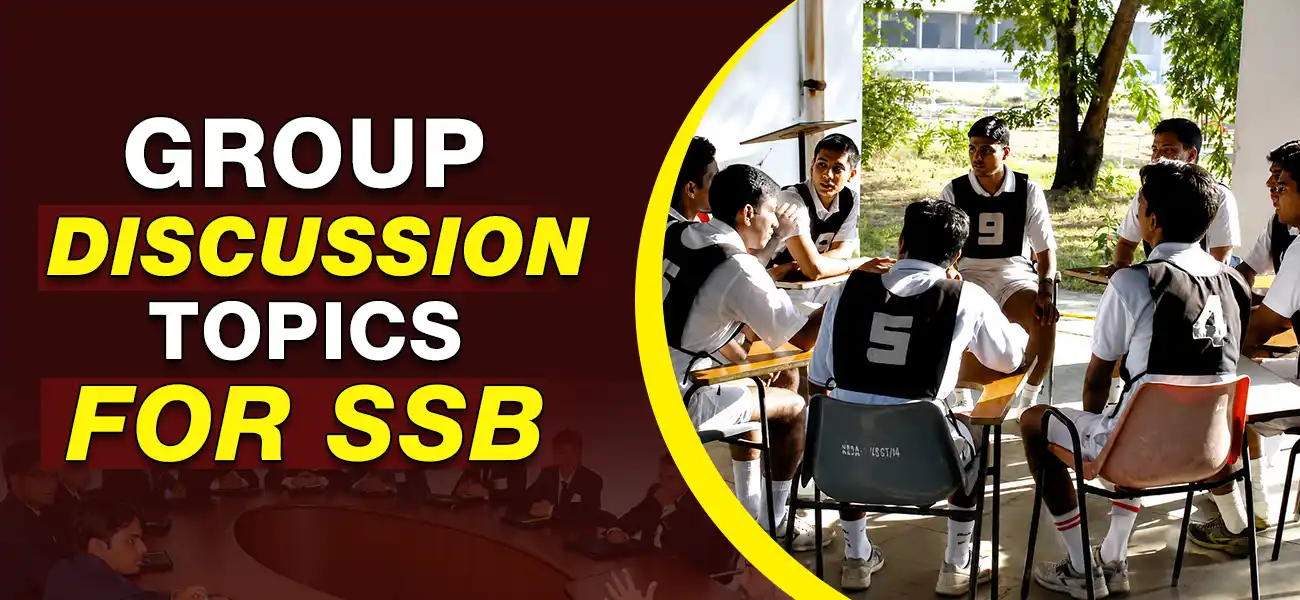
Group Discussion Topics for SSB form one of the most decisive stages in the Services Selection Board interview. The Group Testing Officer (GTO) uses this task to evaluate how well a candidate thinks on their feet, communicates ideas, cooperates with peers, and displays Officer-Like Qualities (OLQs) under mild pressure. Unlike a debate, the focus is not on “winning” but on contributing meaningfully, listening actively, and helping the group reach a constructive consensus.
This detailed guide covers everything aspirants need: the exact process, what assessors observe, the most relevant Group Discussion Topics for SSB, practical speaking frameworks, preparation strategies, and common pitfalls. Whether you are preparing for NDA, CDS, AFCAT or any other entry, mastering these topics will significantly improve your performance.
In the GTO series, candidates are usually divided into groups of 8–12. The GTO gives two successive topics. For each topic:
- You get about 1–2 minutes of thinking time.
- The group discusses for roughly 15–20 minutes.
- There is no formal moderator; the group manages itself.
- Assessors remain silent observers.
The topics generally fall into current affairs, national security and defence, social issues, economic development, technology, or occasionally abstract themes. One topic is often allotted by the GTO, and the second may be chosen from options given to the group.
What Assessors Look For During Group Discussion Topics for SSB
The GTO evaluates core OLQs through your behaviour:
- Clarity of thought and logical expression
- Confidence without arrogance
- Initiative and ability to steer the discussion productively
- Cooperation, respect for others’ views, and team spirit
- Knowledge level and ability to support points with facts or examples
- Emotional stability and positive body language
- Listening skills and the habit of building on others’ ideas
Speaking the most is not the goal. Quality of contribution, relevance, and group facilitation matter far more.
Why Group Discussion Topics for SSB Matter
The GD round is not about winning an argument or dominating the conversation. Instead, the GTO observes:
How you initiate or support the discussion
Your ability to present logical, balanced arguments with examples
Whether you listen actively and encourage quieter candidates to speak
Your body language, eye contact, and confidence while speaking
How you handle disagreements and steer the group toward a constructive conclusion
Major Categories of Group Discussion Topics for SSB
1. Defence and National Security
These remain the most frequently asked and highly relevant for future officers.
- Should women be inducted into combat roles in the Indian Armed Forces?
- Agnipath scheme: strengths, challenges, and long-term impact
- Theatreisation of the Indian Armed Forces – need of the hour?
- Atmanirbhar Bharat in defence manufacturing: progress and remaining gaps
- Role of Artificial Intelligence and drones in modern warfare
- Cyber warfare and its implications for national security
- India’s border management challenges (especially northern and western borders)
- Importance of joint military exercises and defence diplomacy
- Space technology and its strategic significance for India
- Modernisation of the Indian Armed Forces and defence budget priorities
2. Current Affairs and International Relations
- India’s growing role in G20, BRICS, and the Indo-Pacific
- Climate change as a national security threat
- India–China relations and the Line of Actual Control
- One Nation, One Election – feasibility and benefits
- India’s space achievements (Chandrayaan, Aditya-L1, and beyond) and strategic value
- Impact of global conflicts on India’s foreign policy and economy
- Rise of multipolarity and India’s strategic autonomy
3. Social Issues
- Impact of social media on youth and democracy
- Women empowerment: reality versus rhetoric in contemporary India
- Online education versus traditional classroom learning
- Mental health awareness among the youth
- Uniform Civil Code – pros and cons
- Joint family system versus nuclear family in modern India
- Role of youth in nation-building
- Challenges of rural development and urban migration
4. Economy, Technology and Development
- Make in India and Startup India: achievements and hurdles
- Cashless economy and Digital India – inclusivity challenges
- Artificial Intelligence: opportunities and risks for employment
- Skill development versus traditional education
- Privatisation of public sector units – is it the right path?
- Green energy transition and energy security of India
5. Abstract and Value-Based Topics
Occasionally given to test deeper thinking:
- Success versus happiness
- Hard work versus smart work
- Technology making us less human?
- Discipline as the foundation of national strength
These lists of Group Discussion Topics for SSB are drawn from recurring patterns observed in recent boards and expected trends for 2026. The actual topic on the day may be a slight variation, so focus on understanding the underlying issues rather than memorising answers.
Top 50+ Group Discussion Topics for SSB 2026
Here’s a curated list of the most expected Group Discussion Topics for SSB based on recent trends:
Defence & Security (15 Topics)
Agnipath Scheme: Opportunity or gamble?
Women in combat roles in the Armed Forces
India’s defence modernization and Atmanirbhar Bharat
Cyber warfare and national security
Artificial Intelligence in warfare
Theatre commands: The next big reform?
India’s border security challenges (Galwan, Doklam)
Role of DRDO in defence technology
Space technology and national security
Armed forces in disaster management
Nuclear weapons: Deterrence or danger?
India’s defence budget and preparedness
Make in India and defence manufacturing
Military training for youth: Should it be compulsory?
Regimental identity post-Agnipath
Current Affairs & International Relations (10 Topics)
Russia-Ukraine war: India’s diplomatic position
India-China relations after Galwan
India-Pakistan: Is peace possible?
India-US strategic partnership
India’s permanent UNSC seat
BRICS and global cooperation
Indo-Pacific strategy and India’s role
Global terrorism and security challenges
Climate diplomacy and international relations
One Nation One Election: Feasibility
Social Issues (12 Topics)
Women’s empowerment in India
Caste-based reservation: Still needed?
Uniform Civil Code in India
Two-child policy: Should it be law?
Population: Asset or liability?
Education reforms in India
Digital India initiative
Social media’s impact on youth
Mental health awareness among youth
Environmental pollution and climate change
Role of youth in nation-building
Moral values and their importance
Economy & Governance (8 Topics)
Privatisation of public sector banks
Unemployment and skill development
Start-up culture in India
Corruption in public life
Criminalization of politics
Universal Basic Income
Make in India and economic growth
Education vs employment
Technology & Innovation (7 Topics)
Artificial Intelligence and society
Deep fake technology
Data privacy and cybersecurity
Future of robotics
Space exploration vs poverty alleviation
Cryptocurrency: Regulate or ban?
Technology and education
Abstract & Ethical (5 Topics)
Is the death penalty justified?
Media trial vs fair judicial process
Honour killings: Law and society
Gandhian principles in modern India
National security vs personal privacy
How to Perform Effectively in Group Discussion Topics for SSB
Structure your contribution
Use a simple framework:
State your point clearly → Give a brief reason or fact → Support with a short example or data → Link back to the larger issue or national interest.
Opening the discussion
If you know the topic well, a confident, structured opening creates a strong first impression:
“Good morning. The topic before us is highly relevant because… There are multiple dimensions – social, economic, strategic. I would like to begin by highlighting…”
During the discussion
- Enter at natural pauses.
- Use phrases such as “Building on what was just said…”, “I agree and would like to add…”, or “Another perspective worth considering is…”.
- Encourage quieter members politely if the discussion becomes dominated by a few.
- Keep body language open – sit upright, make eye contact with the group, and avoid aggressive gestures.
Closing or summarising
If the opportunity arises, a short neutral summary that captures the main points and suggests a balanced way forward demonstrates leadership.
Practical Preparation Strategy for Group Discussion Topics for SSB
- Read one national newspaper and follow reliable defence and current-affairs sources daily.
- Maintain a notebook of key facts, government schemes, and recent developments under the major categories listed above.
- Practise mock GDs regularly in groups of 8–10. Record yourself occasionally to improve clarity, pace, and body language.
- Develop the habit of seeing every issue from multiple angles – advantages, disadvantages, practical challenges, and possible solutions.
- Work on voice modulation, vocabulary, and the ability to express complex ideas in simple language.
- Stay calm. Even if the discussion becomes heated, a composed demeanour stands out positively.
Common Mistakes to Avoid
- Dominating the discussion or interrupting others repeatedly
- Speaking without facts or going off-topic
- Remaining completely silent
- Using aggressive language or dismissing others’ views
- Looking only at the GTO instead of engaging with the group
- Memorising and delivering rigid speeches that ignore the flow of discussion
Why Consistent Practice Matters
The difference between average and outstanding performance in Group Discussion Topics for SSB usually comes down to regular practice under realistic conditions, feedback from experienced mentors, and the ability to remain natural while displaying OLQs. Knowledge alone is not enough; the way you handle group dynamics is what the board ultimately assesses.
At Indian Defence Institute, recognised as the Best NDA Coaching in Dehradun, aspirants receive structured training that integrates current-affairs discussions, regular mock GDs conducted by experienced faculty (including those with defence background), personalised feedback on communication and body language, and holistic OLQ development. Located in Premnagar, Dehradun, the institute combines rigorous written-exam preparation with continuous SSB exposure, physical training, and a disciplined residential environment that mirrors the values of the armed forces.
Whether you are targeting NDA after Class 12, CDS, or other entries, focused guidance on Group Discussion Topics for SSB at Indian Defence Institute helps transform potential into performance. The right preparation not only improves your chances at the selection board but also builds the confidence and analytical clarity expected of a future officer.
Stay updated, practise sincerely, contribute positively, and approach every discussion with the mindset of a team player who puts the group’s progress above personal spotlight. That combination consistently produces strong recommendations.
Get Free Counselling