
Strait of Hormuz: India’s Energy Lifeline – Why This Narrow Passage Holds the Key to India’s Energy Security
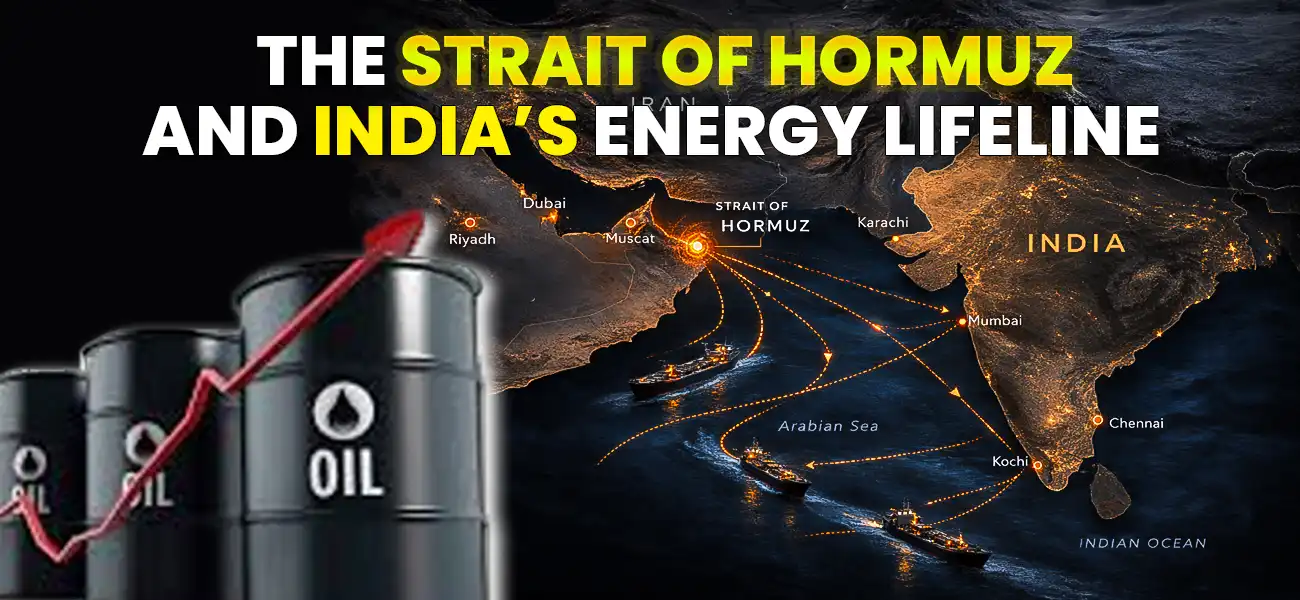
In today’s interconnected world, a single stretch of water can determine the fate of a nation’s economy and national security. The Strait of Hormuz is precisely that strategic chokepoint. Widely regarded as India’s Energy Lifeline, the Strait of Hormuz carries a massive volume of crude oil and liquefied natural gas (LNG) that powers India’s growth. Any disruption here directly threatens fuel prices, industrial output, and everyday life across the country.
Understanding the Strait of Hormuz is not just a matter of geography—it is essential for appreciating India’s maritime vulnerabilities and defence preparedness. This detailed guide explores every critical fact about the Strait of Hormuz, its global importance, and why it remains India’s Energy Lifeline even in 2026.
Geographical Features of the Strait of Hormuz
The Strait of Hormuz is a narrow waterway connecting the Persian Gulf to the Gulf of Oman and the Arabian Sea. It separates Iran to the north from Oman (specifically the Musandam Peninsula) to the south.
At its narrowest point, the Strait of Hormuz measures just 21–33 kilometres wide, with two dedicated shipping lanes—each roughly 3.7 km wide—plus a 3.7 km buffer zone for safe passage. The depth varies between 60 and 100 metres, allowing even the largest supertankers to navigate.
This bottleneck geography makes the Strait of Hormuz extremely vulnerable. Iran controls the northern side, while Oman governs the southern waters. International maritime law (UNCLOS) ensures open passage, but the confined space means even minor incidents—such as tanker attacks or mine-laying—can create chaos for global shipping.
Historical Significance of the Strait of Hormuz
The Strait of Hormuz has been a trade artery for centuries. Named after the historic island of Hormuz (once a bustling Persian port), it featured prominently in ancient Silk Road maritime routes. Portuguese explorers captured the island in 1507, built a fortress, and levied tolls on ships carrying spices, silk, and pearls.
During the 1980s Iran-Iraq War (the “Tanker War”), both sides attacked oil vessels, forcing international naval intervention. Since the 1979 Iranian Revolution, Iran has asserted greater control over the strait. These historical episodes underscore why the Strait of Hormuz has always been more than a shipping lane—it is a theatre of geopolitical power.
Global Oil Trade and the Strait of Hormuz
No other chokepoint matches the Strait of Hormuz in volume and influence. According to the latest 2025–2026 data from the International Energy Agency (IEA) and U.S. Energy Information Administration (EIA):
- Approximately 20 million barrels per day (mb/d) of crude oil and petroleum products transit the Strait of Hormuz—accounting for 20–25% of the world’s seaborne oil trade.
- Around 80–84% of this oil heads to Asian markets.
- Nearly 20% of global liquefied natural gas (LNG) trade also passes through the strait.
- Only limited bypass options exist: pipelines can reroute just 3.5–5.5 mb/d, far short of daily volumes.
More than 30,000 tankers cross annually, carrying over 20% of global petroleum liquids consumption. This makes the Strait of Hormuz the world’s most critical energy chokepoint.
Why the Strait of Hormuz is India’s Energy Lifeline
India imports 85–90% of its crude oil requirements and consumes roughly 5.5 million barrels daily. The Strait of Hormuz is India’s Energy Lifeline because nearly 40–50% of these imports—approximately 2.5–2.7 million barrels per day—travel through this narrow passage.
Key suppliers whose oil reaches India via the Strait of Hormuz include:
- Iraq
- Saudi Arabia
- United Arab Emirates
- Kuwait
Additionally, 60% of India’s LNG imports and a significant share of LPG shipments also depend on the Strait of Hormuz. A prolonged closure or disruption would trigger immediate price spikes, inflation in transport and manufacturing, and potential fuel shortages.
Even with successful diversification (Russia now supplies over 35% of India’s crude), the Strait of Hormuz remains indispensable for Gulf-sourced energy that refineries are optimised to process. This dependence directly links India’s economic growth and energy security to the stability of the Strait of Hormuz.
Geopolitical Risks and Tensions in the Strait of Hormuz
The Strait of Hormuz sits at the heart of regional rivalries. Iran has repeatedly threatened to block the strait during crises, citing its strategic leverage. Recent 2026 tensions involving Iran have already caused temporary shipping disruptions, mine-laying concerns, and heightened insurance premiums.
Past incidents—such as tanker seizures and drone attacks—have shown how quickly the Strait of Hormuz can escalate into a global crisis. Any conflict here would not only affect oil prices worldwide but also endanger Indian-flagged vessels and the lives of Indian seafarers. For a nation aspiring to become a global power, safeguarding the Strait of Hormuz route is a core national security imperative.
India’s Strategic Measures to Protect Its Energy Lifeline
India is not passive in the face of Strait of Hormuz risks. Key steps include:
- Diversification of suppliers: Increased imports from Russia, the United States, West Africa, and Latin America have reduced (but not eliminated) Hormuz dependence.
- Strategic Petroleum Reserves (SPR): India maintains commercial stocks and underground reserves (Mangalore, Padur, Visakhapatnam) capable of covering 40–45 days of consumption in emergencies.
- Naval presence: The Indian Navy regularly deploys in the Arabian Sea and Gulf of Oman under operations like “Operation Sankalp” to escort Indian tankers and monitor threats.
- Diplomatic engagement: Strong ties with Gulf Cooperation Council (GCC) nations and balanced relations with Iran help keep sea lanes open.
These measures demonstrate India’s proactive approach to securing the Strait of Hormuz as its Energy Lifeline.
The Role of Maritime Defence in Securing the Strait of Hormuz
The Indian Navy’s blue-water capabilities and anti-piracy operations directly protect energy routes linked to the Strait of Hormuz. Future naval officers must master chokepoint geography, asymmetric threats, and joint operations with international partners. This knowledge forms the backbone of India’s maritime strategy in the Indian Ocean Region.
Safeguarding India’s Energy Lifeline
The Strait of Hormuz is far more than a distant waterway—it is India’s Energy Lifeline, carrying the oil and gas that fuel our industries, vehicles, and households. Its geographical constraints, massive daily transit volumes, and geopolitical sensitivities make it a permanent factor in India’s national security calculus.
As global tensions continue, India’s ability to protect this lifeline through diplomacy, diversification, strategic reserves, and naval power will determine its energy independence and economic resilience.
For young defence aspirants who dream of serving the nation and understanding such critical strategic realities, comprehensive training in geopolitics, maritime security, and national defence is essential.
Indian Defence Institute, the best NDA Coaching in Dehradun, equips future officers with in-depth knowledge of chokepoints like the Strait of Hormuz, preparing them to safeguard India’s interests on the global stage. Join us to turn strategic awareness into a distinguished career in the Indian Armed Forces.
For structured preparation, join the Best NDA Coaching in Dehradun.
Get Free Counselling